

If you could list the top AI-related skills every undergraduate needs as they start to look for jobs, what would be on your list?
Not generic (but still important) competencies like AI literacy or critical thinking, but practical skills where, in an interview, a student can say “I can do this …” and demonstrate it on the spot.
I was looking for such a list earlier today as I was preparing to speak to a group of students, and was surprised by how little I could find.
Of course there are the big AI literacy frameworks from places like the EU/OECD. And there are a bunch of resources online that list “must-have AI skills.” But these are typically very high level (such as the EU/OECD AI Literacy framework), focus on technical skills (Sarah Moreno’s 12 Essential AI Skills to Master by 2026 is a good example here), or are too mushy to put on a resume and defend in an interview (Purdue’s AI Working Competency approach is extremely useful for instance, but is too high level for students when they’re put on the spot).
And so I sat down and wrote my own list.
This, of course, is not the definitive list — if nothing else because necessary AI skills are a fast-moving target.
But from my perspective as an educator working at the edge of emerging tech and the future, it does give students a series of “I can …” skills that they can describe and demonstrate in an interview. And that — from all I’m hearing —are becoming essential for success, irrespective of what your major is or the career you aspire to.
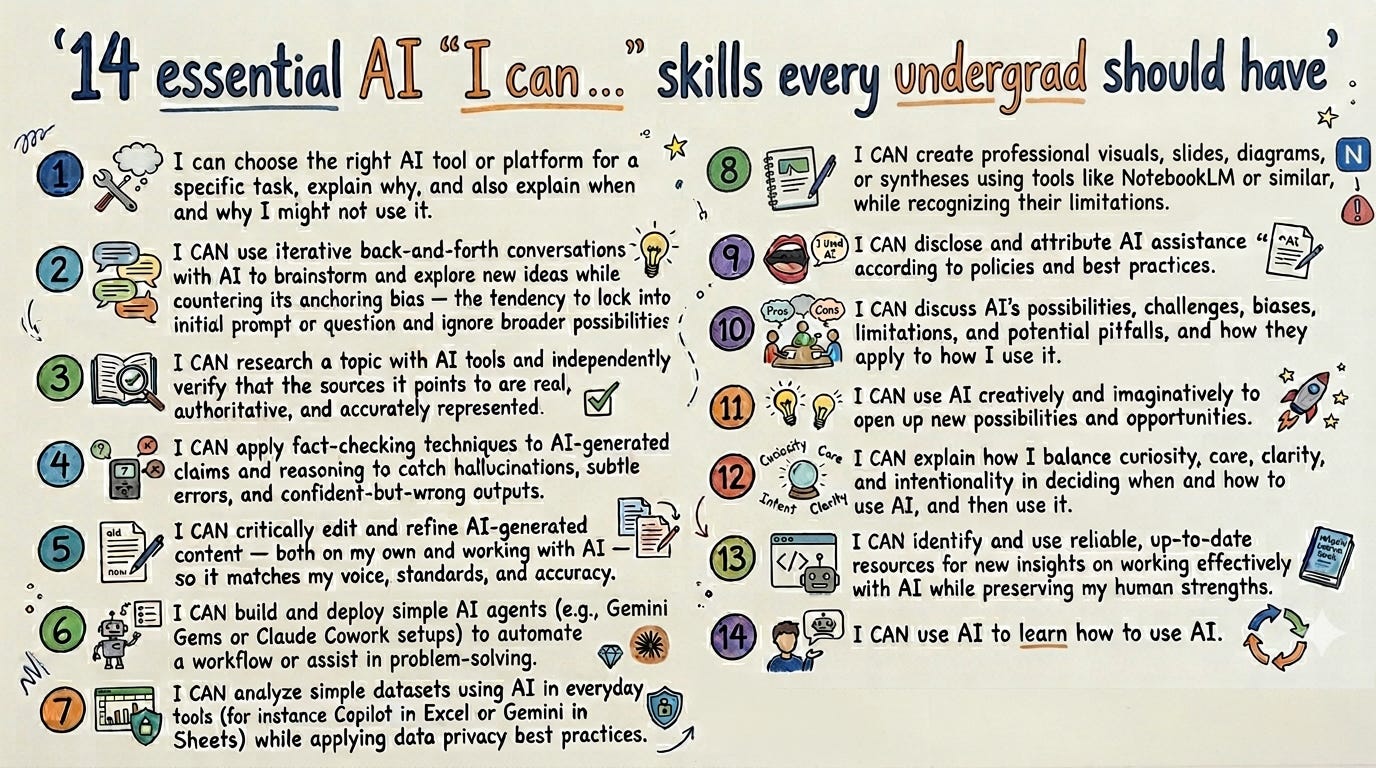
And so, without further ado, here is my list of 14 essential AI “I can …” skills every undergrad should have:
I can choose the right AI tool or platform for a specific task, explain why, and also explain when and why I might not use it.
I can use iterative back-and-forth conversations with AI to brainstorm and explore new ideas while countering its anchoring bias — the tendency to lock into the initial prompt or question and ignore broader possibilities.
I can research a topic with AI tools and independently verify that the sources it points to are real, authoritative, and accurately represented.
I can apply fact-checking techniques to AI-generated claims and reasoning to catch hallucinations, subtle errors, and confident-but-wrong outputs.
I can critically edit and refine AI-generated content — both on my own and working with AI — so it matches my voice, standards, and accuracy.
I can build and deploy simple AI agents (e.g., Gemini Gems or Claude Cowork setups) to automate a workflow or assist in problem-solving.
I can analyze simple datasets using AI in everyday tools (for instance Copilot in Excel or Gemini in Sheets) while applying data privacy best practices.
I can create professional visuals, slides, diagrams, or syntheses using tools like NotebookLM or similar, while recognizing their limitations.
I can disclose and attribute AI assistance according to policies and best practices.
I can discuss AI’s possibilities, challenges, biases, limitations, and potential pitfalls, and how they apply to how I use it.
I can use AI creatively and imaginatively to open up new possibilities and opportunities.
I can explain how I balance curiosity, care, clarity, and intentionality in deciding when and how to use AI.
I can identify and use reliable, up-to-date resources for new insights on working effectively with AI while preserving my human strengths.
I can use AI to learn how to use AI.
If you have others that aren’t here, or have skills you think are redundant (especially if you are actively recruiting students), please do add them in the comments.
And if these are useful, please don’t hesitate to share and use them.
AI Use Statement
Of course, as I’m writing about AI use, how could I not include an AI use statement! As you might guess from the fact that there are 14 skills here and not an even 10, this is an idiosyncratically human list (or maybe just an idiosyncratically “Maynard” list), and draws directly on my own experiences and observations working with students and listening to employers. But I did use Grok to stress-test the idea and check whether I was just re-inventing the wheel, and to sharpen the list up. I also asked Claude for some editing advice on the final list. And of course I used Gemini to create the hero image — although that ended up taking more time than it took to conceive, research, draft, and write the whole piece! But apart from that, what you see is what a human produced!
One competency that is an issue right now (Claude throttling) and ought to be part of the fundamental skillset is token/compute conservation. It is easy enough to throw a ton of junk into an AI thread and drag the dialog through 100 exchanges, but it comes at a terrible (mostly invisible) cost. Turn off unused Skills! Summarize and restart.
Using tokens efficiently saves compute and improves performance. You could even classify this as an ethical issue.
Good list. You may want to check out what businesses are already looking for when hiring. For example, here is what Zapier considers the minimum fluency bar for getting a job with them: https://zapier.com/blog/raising-ai-fluency-bar-in-hiring/ We are past the point of "know how to use different AI tools well" and getting into a world where the expectation is embedding AI into our existing workflows in repeatable ways (rather than one off prompts) and demonstrating quality/efficiency improvements.