

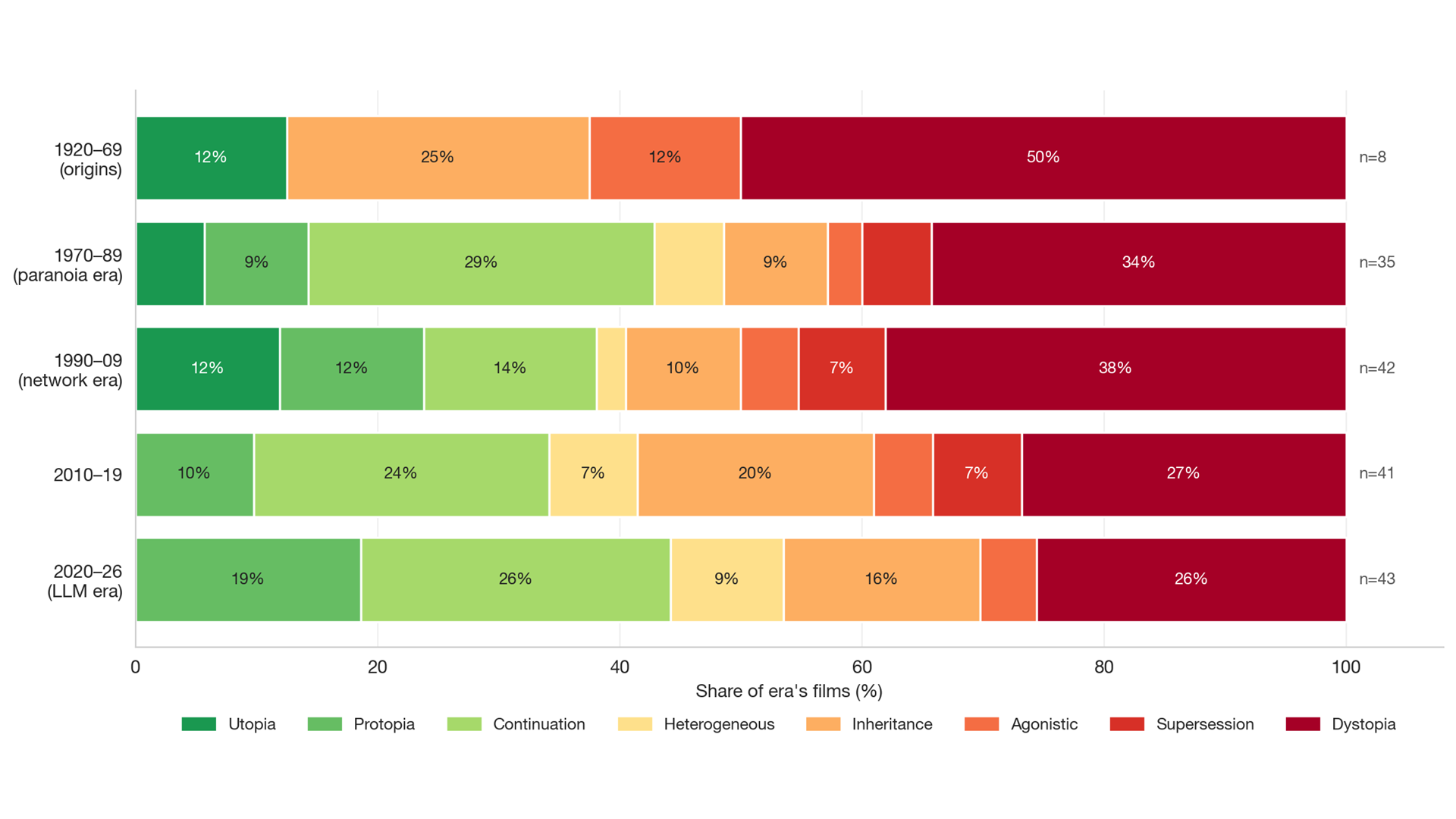
Everyone knows that, when it comes to science fiction movies, artificial intelligence tends to be bad news for the future. Terminator, The Matrix, the latest double-bill in the Mission Impossible franchise — in these and other sci-fi blockbusters AI is the powerful antagonistic tech that threatens dystopia unless stopped.
Except that, deeper analysis indicates that the connection between AI and imagined futures in movies is more complex than this.
I’ve long been interested in how strongly the evidence supports assumptions of AI-driven dystopias in movies. But with one thing and another, I haven’t had the time to sit down and research this thoroughly.
However, spurred into action by a recent post from Anthropic (reported in Ars Technica) that claimed dystopian sci-fi was responsible for for teaching its models to act “evil,” I decided to do some digging.
Perhaps not surprisingly, there’s been a lot written about AI in films and other media and how it reflects visions of the future.1 But despite all my searching, I couldn’t find anything that directly addressed the question of how AI is depicted in movies over the past century has been associated with different possible futures.
And so I sat down with Claude Code and started digging.
The result is an annotated corpus of 169 movies representing the period 1927 — 2026, covering 31 countries and 21 languages. The corpus teases out associations between AI protagonists and antagonists, and eight possible future states as indicated in the films. These cover the usual triad of dystopia, utopia, and protopia. But they also extend to states captured by the concepts of continuation, inheritance, supersession, heterogeneity, and agonism (these are described at the end of the article).
While the research approach used was pretty robust — I was driving the research and assessing it at every step, while Claude was my not-always-reliable research assistant — it admittedly doesn’t rise to the level of a publication-quality study yet. It is, however illuminating and, I think, insightful — especially give how often the “AI movies are dystopic” trope is repeated.
For details on the method and the full database of the films and their assessment, these are available on GitHub — and I’d encourage anyone to feel free to explore and build on the corpus that’s posted here.
You can also explore the full database using this nifty browser: https://andrewmaynard.net/aimoviefutures/
For the highlights though, read on:
Findings
While I was fully in the driver’s seat as the corpus was developed and assessed, the following data visualizations are primarily the work of Claude Code as I directed it to analyze and visualize the data. I decided to use them as-is as they are pretty close to what I would have produced given the time, and despite being a little clunky in places, they provide useful insights.
Before you look through these, it’s worth noting that the future states categorizations are subjective — meaning that someone else may come up with a different assessment (although we did check our analysis for robustness). If you’re interested, the methodology used is described in the GitHub repo, and reflects the reality that few movies are completely black and while when it comes to associations between AI behavior and future states.2
The majority of movies are not dystopian
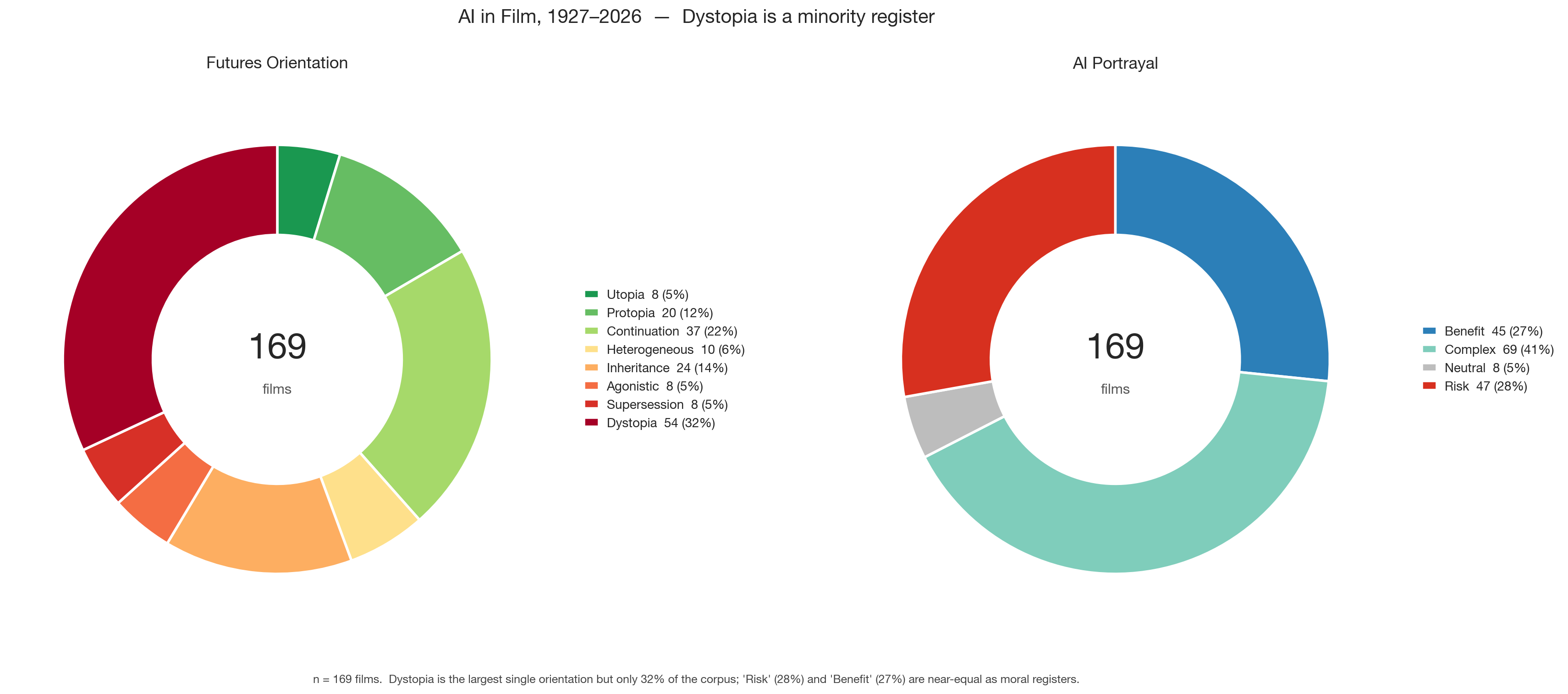
Looking at the complete corpus, while there are a sizable number of movies where AI is associated with dystopian future states (32%), the other categories dominate when combined. Projected futures that are simply a continuation of the present come in second at 22% of the movies, and protopian futures at 12%.
The percentage of dystopian movies over time has been declining since 1927
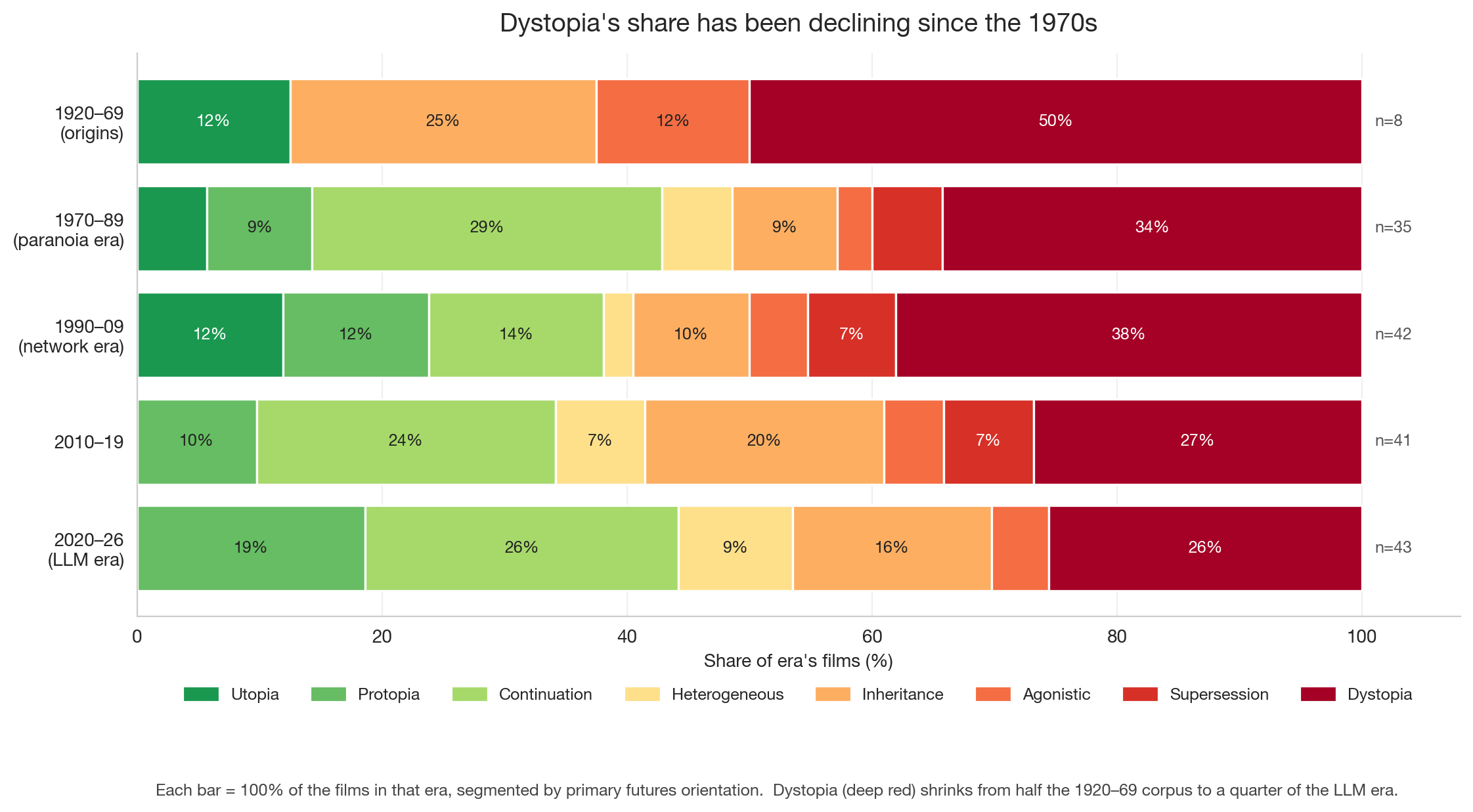
This was a surprise to me — although remember that these are aggregated over all countries and languages, and so hide country-specific trends.
That said, there is a clear indication that the number of dystopian AI movies being made is declining, and the number of protopia movies is on the rise.
This is further unpacked in the following table:
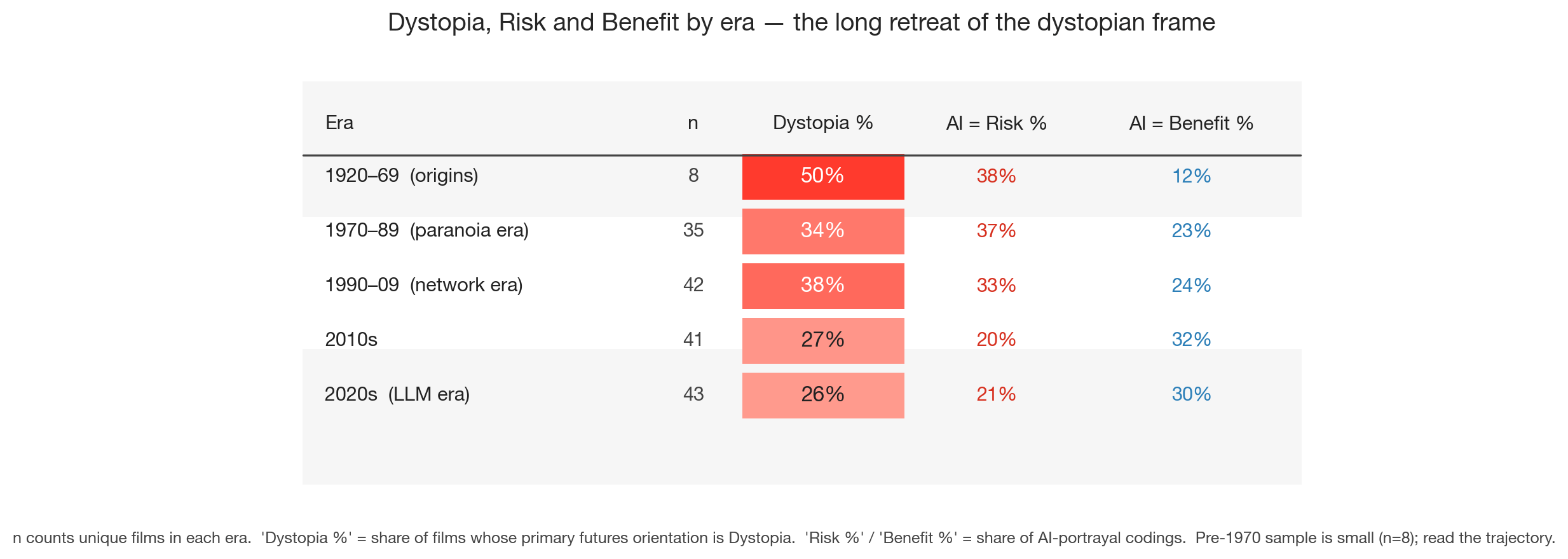
Not only are dystopian AI movies on the decline, but there’s a slight trend toward movies that focus on AI benefits rather than risk
US movies are the least dystopian
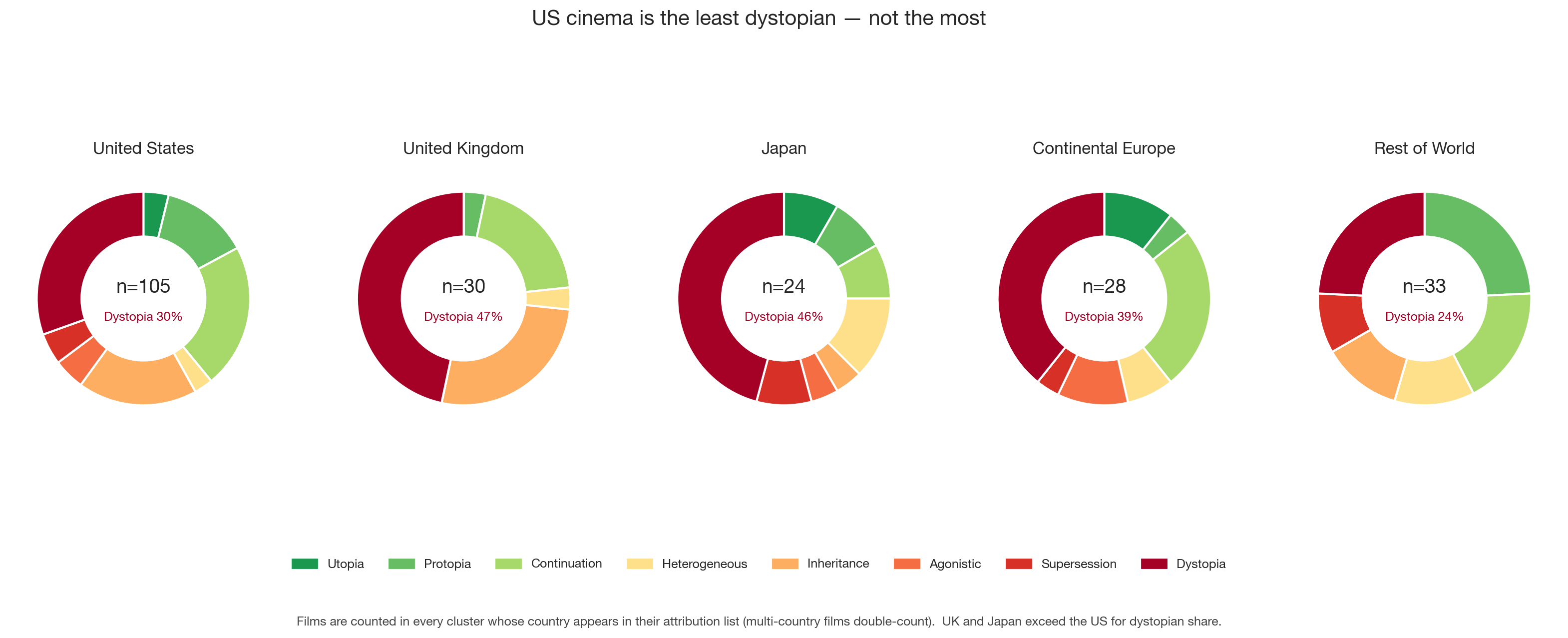
Another surprising outcome — looking across five countries/regions, movies coming out of the US are least likely to be dystopian.
Of course this only tells part of the story. A blockbuster Hollywood dystopian AI movie will likely have far more influence and impact on society than a small indie movie. And this is a layer of analysis that its worth pursuing in the future.3 But just based on assessed future state, the US comes out more positive than countries like the UK and Japan.
Future state vs AI portrayal
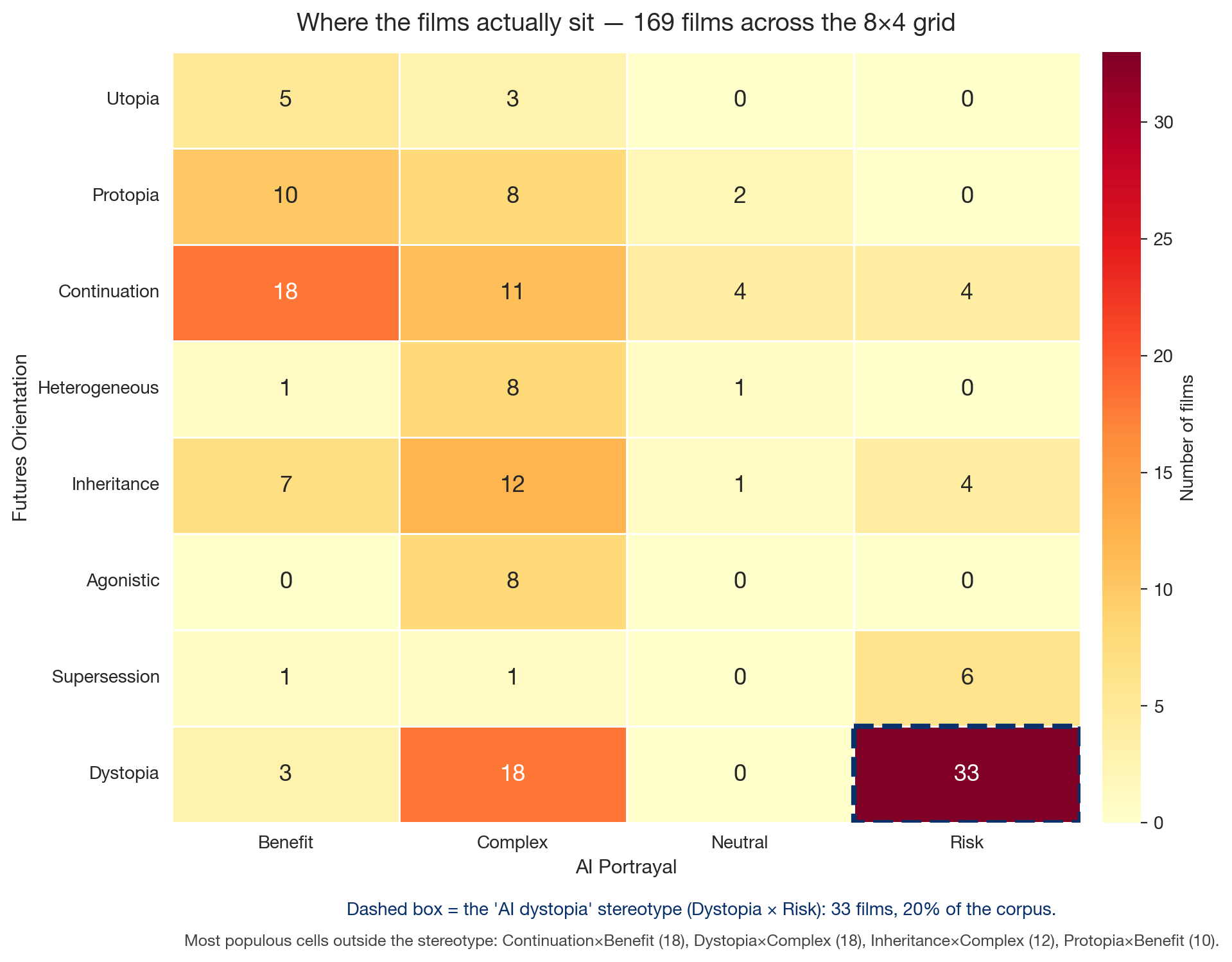
This plot gets a little more complex, but shows the relationship between the projected future state in a movie, and how the AI in the movie is portrayed — whether it represents a risk, a benefit, is neutral, or whether its portrayal is complex (see the notes at the bottom of the article for descriptions of these categories).
As expected, there’s a clear overlap between dystopian futures and risk. Similarly, beneficial AI portrayal tends to cluster around continuation futures and protopias. Also, perhaps not unexpectedly, complex portrayal of AI is all over the map.
This is captured in more nuance in the Sankey plot below which looks at how each future state maps onto how AI is portrayed in a movie:
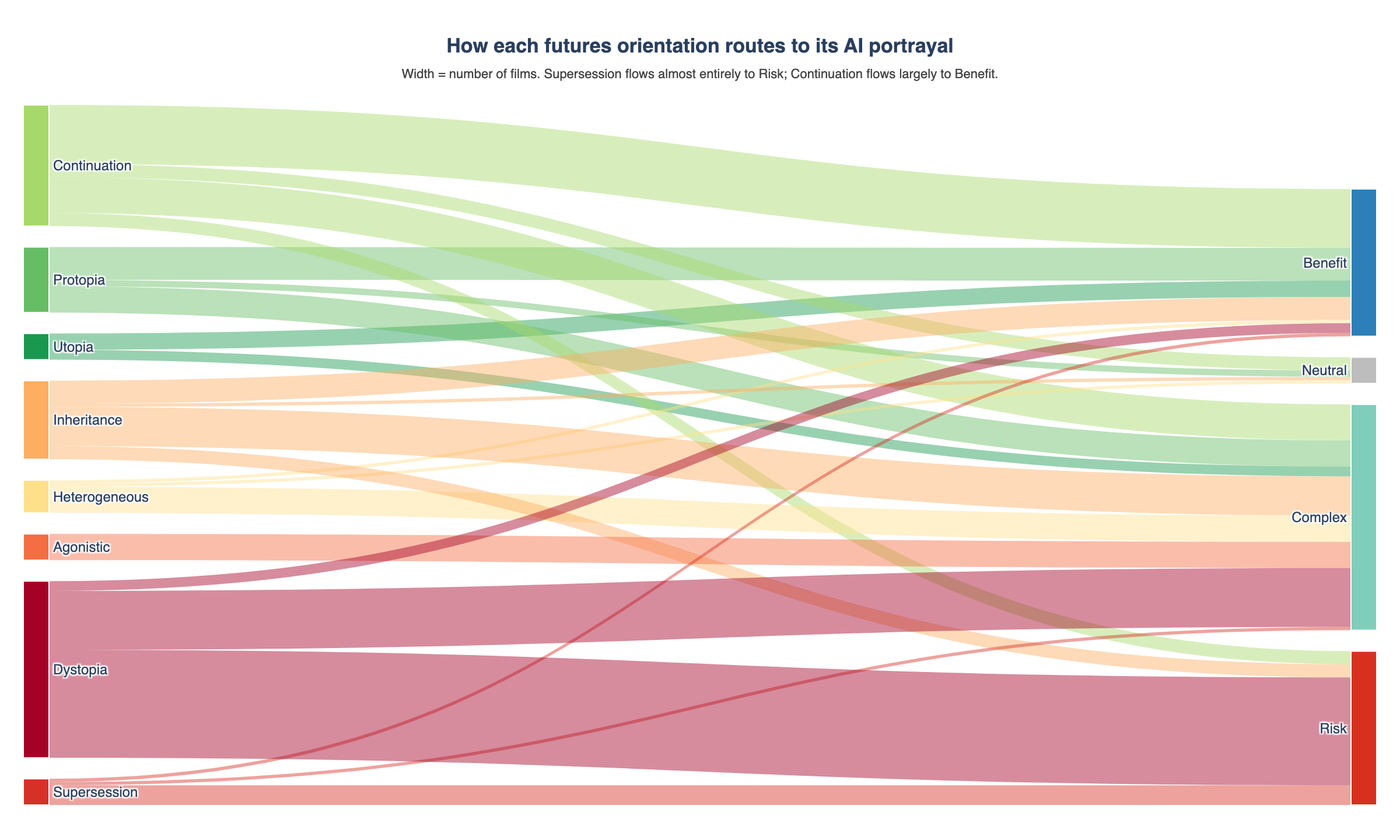
The interesting lines, of course, are the counterintuitive ones — dystopian futures connected with beneficial AI, and continuation futures connected to risky AI for instance.
Bottom line
This analysis is, of course, not definitive. But it does help to begin unpack nuances around how AI portrayal in movies is connected with the types of futures those movies project. And it does start to peel away at assumptions that AI gets a bad rap in films.
It also highlights the instances where AI portrayal is complex in movies — where there is no bright line between artificial intelligence and a particular future state.
And it shows that the landscape around AI and is changing.
The question, of course, that the analysis doesn’t answer, is how all of his impacts on how the relationship between AI, society and the future is potentially impacted by how these are portrayed in movies.
That, though, is a question for another day — which is why I’d encourage you to dig around in the underlying data, and build on it!
Useful stuff
Taxonomy of future states
Using a combination of literature review and inductive analysis, eight future-states were used in this analysis:
Dystopia: The depicted future is substantially worse than the present. Humans suffer in a degraded world. AI is the cause of, contributor to, or instrument of the worsening. Humans remain the unit of futurity (the species is the protagonist of the suffering); they have not been displaced by another category of being.
Utopia: The depicted future is realistically stable with Maslow’s hierarchy of needs met — physiological, safety, belonging, esteem, self-actualization. Not perfect, not impossible — but functionally good and persistent. AI may be infrastructure, partner, or absent-but-presupposed.
Protopia: Incremental improvement as direction not destination. The future is a positive trajectory with no claim of arrival. Following Kevin Kelly’s coinage: protopia is becoming, not arriving.
Continuation: The future is the present plus AI. Structurally unchanged, banal, intimate. No civilizational transformation, no normative claim, no inheritance succession. The AI has changed the texture of personal and domestic life without changing the structure of the world.
Inheritance: Succession welcomed. AI or synthetic continues as the inheritor of human civilization, memory, project, or being. Humans are no longer the active unit of futurity, but their continuance — through synthetic substrate or evolutionary succession — is positively framed by the film.
Supersession: Succession forced or catastrophic. Humans defeated, displaced, contained, or “extincted” by AI or synthetic. Succession depicted as loss, defeat, or imposition. The structural feature is the same as Inheritance — humans are no longer the unit of futurity — but the valence is negative.
Heterogeneous: Multiple distinct futures coexist in the same film without synthesis. The film sustains rather than resolves the multiplicity. Different parts of the depicted world are in different future-conditions and the film does not collapse them into one.
Agonistic: The film’s argument is that the future cannot be cleanly resolved, or that the contestation itself is the depicted future. Held-open as thesis, not as accident or as reception ambiguity. The openness is structural to the film’s claim.
(see GitHub repo for more information)
Descriptions of AI portrayal
Risk: The AI is predominantly framed as threatening, dangerous, or harmful — to characters, to humans, to civilizational values. Even when ultimately defeated or reformed, the dominant valence is “this AI is something to be feared or contained.”
Benefit: The AI is predominantly framed as helpful, beneficial, or positively contributing — to characters, to communities, to outcomes. Even when imperfect or limited, the dominant valence is affection, gratitude, or admiration.
Neutral: The AI is mostly background, infrastructural, or instrumental — present but not the affective center, neither threat nor companion. The film’s interest lies elsewhere; the AI functions as set decoration, plot mechanism, or environmental texture.
Complex: The AI is portrayed in mixed, ambivalent, or contested terms — sympathetic and threatening, helpful and disturbing, or shifting register across the film. The film deliberately resists collapsing the AI into a single valence.
(see GitHub repo for more information)
Methodology
Rather than duplicate this here, if you are interested, check out the GitHub repo for more information.
Th associated GitHub repo has a bibliography of articles and papers that informed this analysis, including works by Stephen Cave, Kanta Dihal, Ed Finn, Ruth Wylie, Mickael Piero, and others.
For movies categorized as dystopian in particular, this was based on an AI being directly and intentionally associated with a projected future dystopian state — not necessarily the world as it is at the end of the movie, but where it is heading, or would be without intervention. For more see the GitHub repo.
Thanks, this is really interesting. I'd like to see some proxies for "reach" for each of films. Are box office numbers available? I.e. do the most popular films lean towards dystopia?