

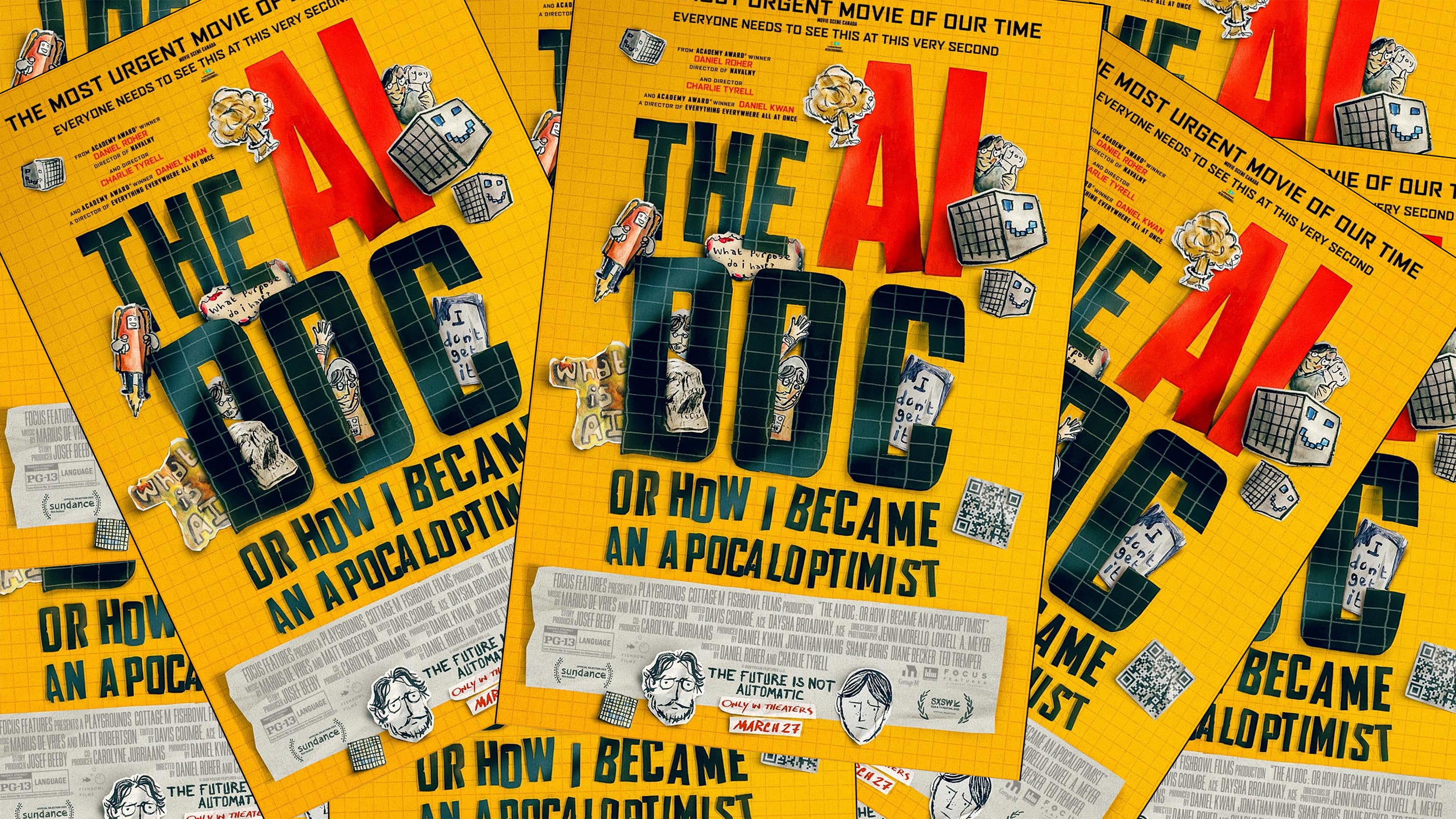
This coming Thursday, a new documentary grappling with the threats and opportunities of AI from directors Daniel Roher and Charlie Tyrell opens in US cinemas.
There’s already a buzz growing around The AI Doc : Or How I Became An Apocaloptimist, with some seeing it as one of the more balanced and insightful AI films to come out in some time.1 And, it has to be said, the framing of the film (existential angst around bringing a kid into a crazy AI world) and a A-list cast of interviewees — from Sam Altman and Demis Hassabis to Karen Hao and Tristan Harris — tick a lot of boxes.
But does it hit the spot?
I was in Copenhagen this past week to give a keynote at The Summit — a gathering of Nordic leaders, innovators and organizations co-hosted by the Confederation of Danish Industry and the Copenhagen Institute for Futures Studies. And had the unexpected opportunity to attend a screening of the documentary ahead of its US release as part of the Copenhagen International Documentary Film Festival (CPH:DOX).
And so, cold Danish beer in hand, and in a packed theater surrounded by avid documentary fans, I did.
And I had a very enjoyable evening — topped off by a question and answer session with three of the the documentary’s producers, Shane Boris, Diane Becker and Ted Tremper.
The documentary progresses through the eyes of director Daniel Roher as he faces a tsunami of existential AI angst while grappling with the responsibility of becoming a father. Motivated by a fear that artificial intelligence could spell the end of everything that matters, he sets out to interview some of the largest (and loudest) voices in AI to fathom out whether this is the best of times of worst of times for him and wife ( film maker) Caroline Lindy) to bring a kid into the world.
The setup works well as we share Daniel’s highs and lows as he brings person after person into his “makeshift” studio, and grills them about AI. And it’s hard not to be impressed by the people the crew managed to persuade to talk with him. There are even a couple of quite delicious non-appearances by Elon Musk and Mark Zuckerberg!
From a film-making perspective the pacing, the narrative, the emotional roller coaster of a journey, all hit the spot. It’s an accomplished piece of documentary making that also packs a punch. And for me, watching it in that packed theater was the perfect end to a great week spent talking with interesting people about tech and the future.
In other words, I’d definitely recommend heading out to see it — even without the cold beer and a crowd of Danish documentary enthusiasts.
Having said that, this is a recommendation that comes with some caveats.
Like all documentaries, The AI Doc sets out to tell a specific story in a particular way. And here, it achieves what the directors and producers set out to do very effectively. It’s touching, funny, shocking, and thought provoking.
But this isn’t the nuanced story about AI that I would tell, given the chance. (and, of course, this is probably why I haven’t been given the chance!)
Despite its impressive cast of characters, the documentary’s missing — at least from my own work and perspective — a huge swath of expert insights around responsible, ethical, and safe AI. The people who are interviewed grab the attention, and theres no question that they make for a riveting documentary. But there’s a point where I found myself feeling that I was being drowned in opinions that were only loosely tethered to reality — whether from the techno-doomers or techno-optimists being interviewed.
And the documentary is most definitely light on some of the more nuanced challenges around responsible development and use of AI, from the risk of weakened infrastructure and the dangers of premature adoption, to growing concerns around impacts of AI on behavior and wellbeing.
However, it was not my documentary — than goodness, as no-one would come to watch it if it was! And there is something rather churlish about reviews that overlook what has been achieved and, instead, focus on what they think has not.
And so I thought I’d wrap this piece up with five ways of appreciating and enjoying the documentary while also digging deeper into navigating opportunities and challenges associated with increasingly powerful AI capabilities.
First off, go watch the documentary — it’s well made, entertaining, and thought provoking. And as you watch it, enjoy it, think about it, talk about it, explore how it intersects with your experiences and your perspective. As a conversation starter, the film definitely achieves what the directors and producers set out to do.
Second, remember while watching it that this represents a substantial and very intentional creative project, and the team behind it did an amazing job — even more so given how fast the AI landscape was changing as they were making it. In the Q&A session in the screening I attended, producer Ted Tremper noted that they nearly had an existential crisis of their own when Sam Altman was removed as CEO of OpenAI in 2023, and then reinstated 72 hours later — an apt reflection of the whole AI roller coaster they were trying to capture.
Third, remember that, if you are not deep in the weeds of AI, the complexities of the technology’s potential impacts on society and the future are near-impossible to capture in a documentary that people will actually watch. And in this context, the narrative choices the team made make far more sense than they might otherwise do. As Ted Tremper said in the screening’s Q&A in Copenhagen, the documentary needed to act as a “first date” with the audience — revealing enough to invite a continuing conversation rather than killing the relationship with too much information - or just being a jerk!
Fourth, lean into the “first date” analogy and use the documentary as a jumping off point for taking things further — not as a definitive guide, but as a catalyst for further exploration. I would, of course, strongly recommend reading AI and the Art of Being Human as the perfect next-date, but I’m sure others will have other suggestions.
And finally, enjoy the story telling for what it is. Not as a lecture on the absolute truth about AI, but as an entry point to thinking further about a technology that will have a profound impact on our lives, whether that’s apocalyptic, optimistic, or — most likely— something way more nuanced in between these extremes.
And when you have seen it, let me and others know what you think in the comments!
I do feel there’s a missed opportunity here for a new word — AIpocaloptimist — that uniquely captures the angst around extreme uncertainties and outcomes seemingly associated with AI futures. Am I an AIpocaloptimist? I’m not sure, but I may need to add it to my bio anyway …