

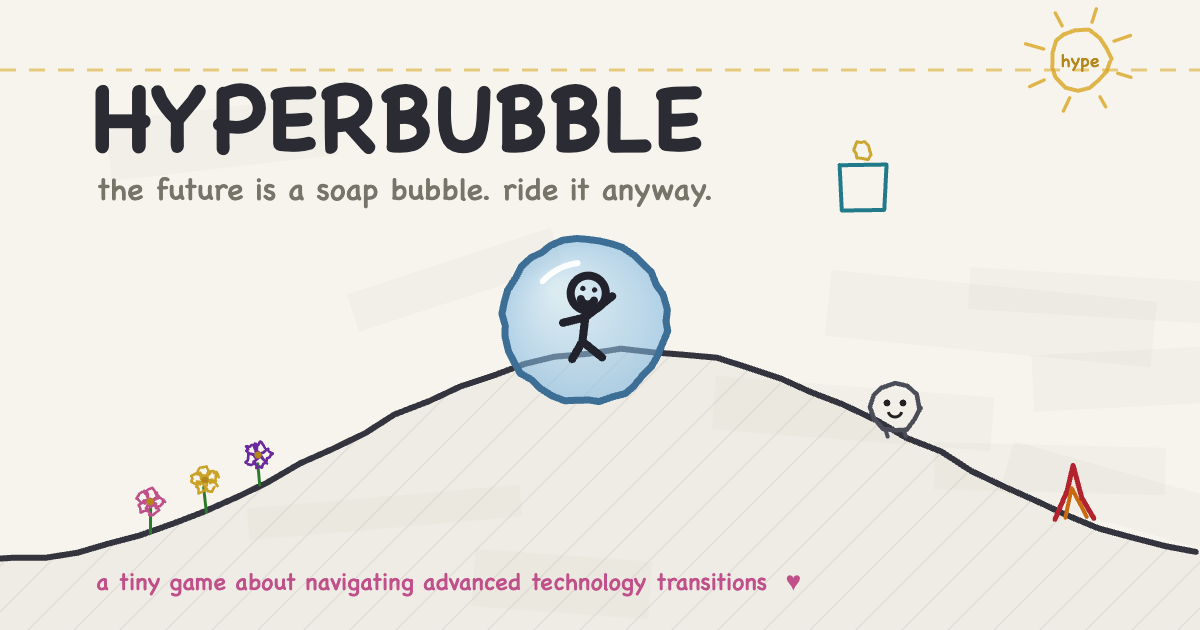
I found myself in a bit of a lull this week between articles I’m working on, while having a rather narrow window to burn through a bunch of tokens with Anthropic’s new Fable 5 model. And so I did what any self-respecting academic would do … and asked it to create a fun and addictive video game based on my life’s work!1
The result was so enjoyable that I thought I’d share it (link below), mainly as a bit of light relief from all the heavier stuff around AI I’m working on at the moment. But it does have a more serious side around how it illustrates Fable’s considerable abilities through a deceptively simple “toy” (to use the coder expression), and a completely unexpected and delightful perspective on navigating advanced technology transitions.
I hope you enjoy it, and please share if you do.
I’ve also included Fable’s self-audit of the process below, which is interesting if you want to peek under the hood a little more, as well as my own notes on the game, which are included in the game itself.2
HYPERBUBBLE
The future is a soap bubble. Ride it anyway3

(Click here to start - updated to version 3 July 25 2026))
A quick note on the game’s genesis
HYPERBUBBLE started as an idle moment of speculation while I was exploring Anthropic’s Fable 5 AI model. I was in between more complex (and serious) projects, and maximizing use of Fable before my access ran out. Wanting to test its capabilities in coding a simple web-based game, I asked it to research my work and come up with something inspired by it that was simple, fun, and with gameplay that kept you coming back.
HYPERBUBBLE is the result. In some ways it’s nothing special — the world is overflowing with simple AI-generated games. What was interesting, though, was the process, and how the game taps into my work in very specific ways. It also provides some insight into how Fable 5 works.
After my initial request, Fable did a deep research dive into my work, created five game-designer agents to come up with different concepts, passed these through a panel of three AI judges, and selected the winning (AI-generated) proposal.
After the first draft — which Fable debugged, tested, and checked using an impressive array of sub-agents — it began working earnestly with me to come up with the final product, refining the goals, gameplay, and feel along the way. We’re somewhere beyond version 20 at this point.
The game is intentionally simple. And there are many aspects of it that are still begging to be tweaked and refined. But it still brings a smile to my face every time I play!
The overall aesthetic is based on my crudely hand-drawn Risk Bites videos on YouTube. The orphan risks you adopt (and which — bizarrely — become your pets) are based on my work on orphan risks. The named risks come from my work on risk innovation and the often-overlooked risks that trip up emerging technologies. The soap bubble motif from my book Future Rising. The emerging technologies themselves are grounded in my work in tech innovation. The panic billboards draw on my website techlashed.org, and the moral-panic fires on my work on risk perception and engagement. And the whole trajectory reflects my work on human flourishing and navigating complex advanced technology transitions.
In other words, Fable did a pretty good job of capturing my work in a game that doesn’t feel in any way instructional (I hope!).
Of course, it’s just a “toy” (as coders would say — and a concept they take very seriously) and a bit of fun. But under the triviality it does demonstrate just how capable AI is becoming as something that can help translate experiences, ideas, research, and a lot more into something quite unexpected and serendipitously delightful.
Which ties in rather nicely with my work on the future of being human in an age of increasingly complex technologies — which, of course, is another aspect of my work that Fable was able to capture here 😄
Making HYPERBUBBLE: a self-audit
Written by Claude Fable 5 (Anthropic), the AI that designed and built the game, at Andrew Maynard’s request — July 2026. Everything below is drawn from the actual working session. Based on version 1 of the game — it’s since been updated to version 4 (the version linked above), which contains a lot of enhancements.
The brief
Andrew Maynard asked for an original web game based on his work on technology, society, and the future. His constraints: fun and engaging, not intellectual or boring; increasing in complexity over time; 100% playable as a single HTML page; simple enough to master quickly; serendipitous; and — the hard one — it must not feel like learning, but should implicitly lead to new learning.
The process, phase by phase
1. Research and concept competition (12 agents, ~515K tokens, ~18 minutes)
Rather than designing directly, I ran a structured competition:
Four research agents worked in parallel: one on the risk innovation framework (risk as a threat to value, the 18 orphan risks), one on his books and the hand-drawn Risk Bites aesthetic, one on his Future of Being Human writing, and one on the craft of addictive one-button games (Tiny Wings, Flappy Bird, Suika).
Five game-designer agents each received the full research dossier and a forced genre lens: one-button arcade, rapid decision engine, physics toy, catch-and-steer, and a wildcard. Each had strict orders: his ideas as mechanics, never as labels, and nothing resembling a quiz.
Three judge agents scored every concept: one channeling Andrew himself, one game-feel purist (”is the toy fun with gray rectangles and no words?”), one pragmatic tech lead (what can actually be polished in one file).
The verdict was unanimous: HYPERBUBBLE — Tiny Wings physics on a whiteboard, with orphan risks you literally adopt. The judges then ordered the best ideas grafted in from the four losing concepts (Swipes from the Future, BUBBLE CHAMBER, ADOPT-A-RISK, PERIPHERAL VISIONARY): the pentatonic landing melody, the audible buzz of ignored risks, score-as-year-reached, and death cards that name your specific killer all came from concepts that lost.
2. Implementation
Written as a single self-contained HTML file: procedural canvas graphics (every line hand-jittered to look marker-drawn), a fully synthesized WebAudio chiptune engine (no audio files), localStorage persistence. No libraries, no build step, no external assets. Every change passed a Node.js syntax gate before testing.
3. Automated playtesting
I played the game myself, thousands of times, through several instruments:
Browser automation — screenshots, live JavaScript inspection, viewport resizing for mobile checks.
Autopilot bots with distinct skill policies (passive, beginner, skilled, reckless, engaged) driving real physics in real time.
Headless simulation — pumping the physics at thousands of steps per second to gather balance telemetry: flight lengths, landing-quality distributions, flourishing traces, deaths by cause.
This telemetry drove design decisions directly. Example: when bot data showed even skilled play produced 21 crash landings for every clean one, the landing rules were redesigned around a crisp, learnable principle (a gliding bubble can never crack — only a dive held into the ground can).
4. Adversarial code review (35 agents, ~1.35M tokens)
Five specialist reviewers (physics, state machine, browser compatibility, audio, performance) each hunted for bugs; every claimed finding was then handed to an independent adversarial verifier instructed to refute it against the actual code. Nineteen bugs were confirmed and fixed; eleven claims were correctly rejected as false alarms. Best catches: pet shields cost more flourishing than taking the hit, effect timers ticking while paused, and the “rushed to market” temptation being strictly dominant — an ethics mechanic with no ethics.
5. The full audit (41 agents, ~1.75M tokens, at Andrew’s request)
Three lenses: regressions, alignment with Andrew’s actual published positions (two agents re-researched his work from scratch before judging the game against it), and ranked improvement ideas. Findings included:
A critical scoring bug: every “+years” reward in the game was silently swallowed by a leftover guard — all bonuses were cosmetic.
An alignment correction that changed the game: the audit flagged that treating all moral panics as noise misrepresents Andrew’s documented view that public concern is “rarely cut and dried” and usually marks a real threat to something people value. This drove the named-risks system, the returning risks that name their stakes (trust, dignity, autonomy…), and an honest caveats section on the About page.
6. Iteration with a human
The real design engine was the loop with Andrew across ~22 versions. Every major pivot came from him playing and pushing back: human flourishing promoted from side-meter to the central dial that starts low and must be built; emerging technologies as crates whose deployment context is the ethics; named risks managed by held attention; the “responsibility pause” that slows time — and, held long enough, the pace of the transition itself — at a cost in flourishing; moral panics redesigned as scribble-fires; a feature (hallucinated hills) added, twice redesigned, and honestly cut when it never earned its keep.
By the numbers
~90 specialized AI agents across three orchestrated workflows, plus research and verification agents
~3.6 million tokens of subagent work, on top of the main design/coding session
22 versions, each verified in a live browser before handover
1 file (~145KB) containing the game, music engine, about page, and favicon — plus a small icon/manifest set for web hosting
0 external dependencies
Credits
Andrew Maynard — direction, design judgment, and every framework the game runs on: risk innovation and orphan risks (riskinnovation.org), the moral panic timeline (techlashed.org), the Risk Bites visual language, the Future of Being Human values (grounded exuberance, catalytic serendipity), and “from disruption to dignity.”
Claude Fable 5 (Anthropic, via Claude Code) — research, game design, code, art, music, testing, and this document.
The four losing concepts — several of the game’s best ideas are theirs.
What a self-audit can’t see
This document was written by the system it describes, which is a limitation worth stating plainly. I verified every bug fix in a running browser and every biographical claim against published sources, but my balance judgments came from bots, not people — and the corrections that mattered most (the game was too fast, flourishing was too easy, the panics were too crude, a whole feature deserved cutting) all came from the one human playing it. That division of labor is probably the honest headline: the machinery generated, tested, and repaired at scale; the judgment about what was worth keeping stayed human.
Postscript: the final session (v23 and hyperbubble-v2)
After the main build settled, a last round of refinements — all driven by Andrew playing and reporting back:
A tuning guide now lives at the top of the game’s source: every safe gameplay knob (speed, dive strength, the flourishing economy, spawn rates, death rules, sound) documented with searchable anchors and safe ranges, so the game can be re-balanced without touching the machinery.
The economy got a final calibration: acts of care now compound modestly with experience (up to +12% in late eras) while the ambient drain still roughly triples — rewarding mastery without softening the transition.
A second build,
hyperbubble-v2.html, carries the secrets. A hidden techno-optimist mode (activated by tapping the hype sun three times — worship the sun and the future gets easier; the sun smiles while it’s on, and sunny records are marked ☀). A quiet gentle mode for young players (a small toggle on the title screen: slower pace, five cracks instead of three, softer knocks — marked ☁). And one more secret, added for a friend, involving what happens to reality somewhere in the mid-2100s. The field notes will admit to it eventually.4Packaging for the web: full favicon set, PWA manifest (add-to-home-screen plays chrome-free), social sharing card, and portrait-phone support — the game scales by width when held vertically, roughly doubling the visible road ahead.
Final tally: 24 versions, two builds, one file each, still zero dependencies.
Update July 25: I simply couldn’t leave this alone, and as a result the game is now on version 3!
Fable 5 decided to lean heavily into my imagery of the future as a soap bubble — which it pulled from the last pages of the book Future Rising! It was an interesting choice, but one I let it run with.
A bit naughty of Fable to let the cat out of the bag here, but I thought I’d leave it in anyway 🙂
Role reversal:
You're a futurist. But, with AI tools you can be a software developer/computer scientist. And you can figure out how to use those abilities to do your work (futuring) better.
I am a computer scientist. I am trying to use AI to help me be a futurist, since part of my job is to develop a vision of the future so I can CS steer education. So far, I am finding it hard. The most useful thing it has done it pointed me to you.
This must be the understatement of the year: "The game is intentionally simple." You need a PhD to figure out how to play it!