

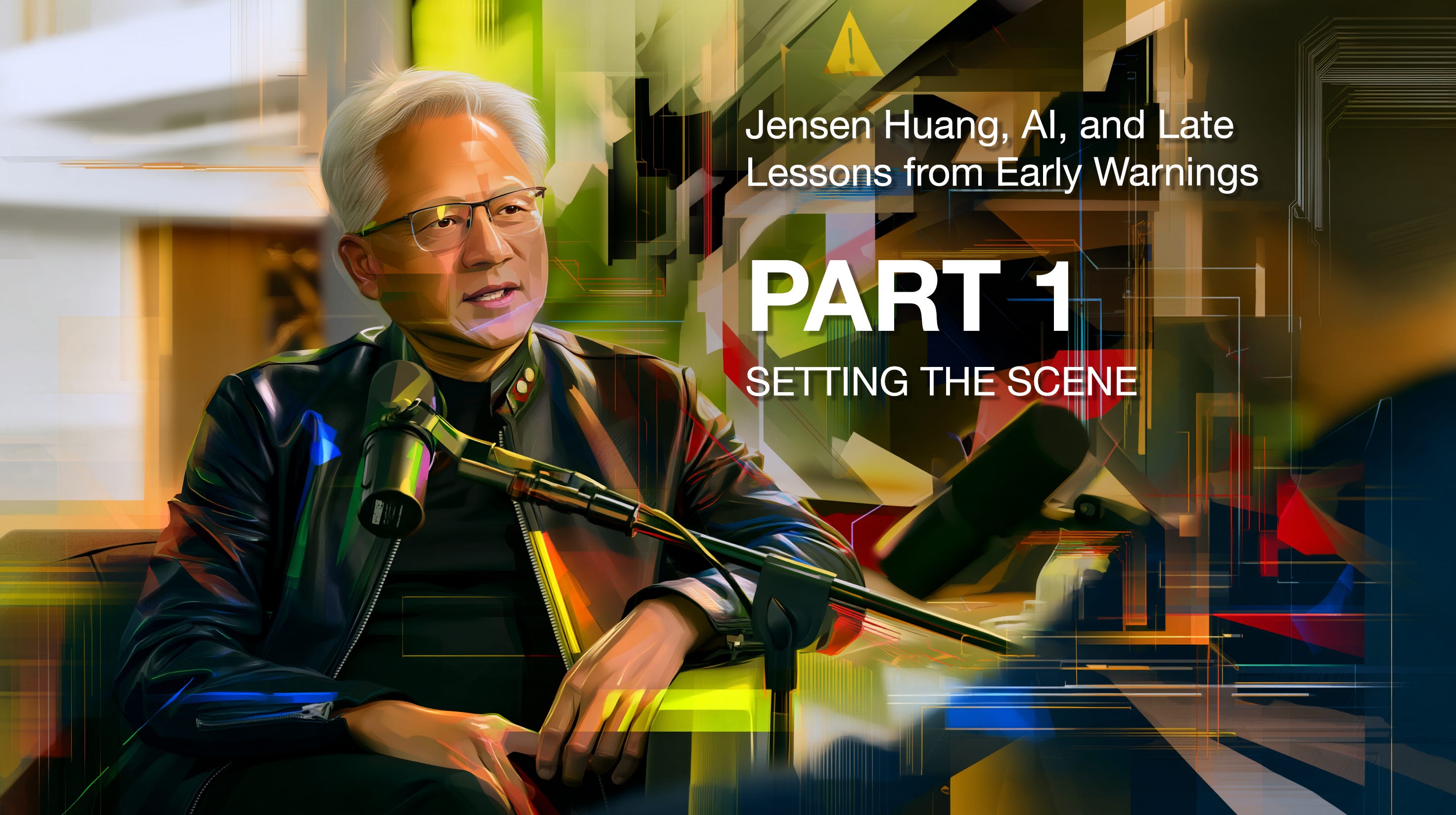
Part 1 of a three-part series. Part 2 coming September 28, and part 3 coming September 29.
In 2001, the European Environment Agency published the report “Late lessons from early warnings: the precautionary principle 1896–2000.” And in 2013 this was followed up with the report “Late lessons from early warnings: science, precaution, innovation.” While both brought a particular frame to bear on the consequences of ignoring early warnings of potential harm around new and emerging technologies, they nevertheless captured decades of research and thinking around how to avoid missteps in the face of high-speed, high-impact, and potentially high-risk, emerging technologies.
Despite this, neither report has received much attention as frontier AI models continue to raise questions around how to ensure their safe, beneficial, and responsible development and use. Yet, listening to the recent — and much-talked about — conversation between Ezra Klein and NVIDIA CEO Jensen Huang, I couldn’t help but be reminded of some of those late lessons, and wonder how they might apply to this moment in AI’s development.
My initial thought was to run off a quick post on claims made by Huang that felt naive and misguided against over two decades of thinking around decisions in the face of technological uncertainty. But then I caught myself before slipping into the trap that most other commentators seem to have fallen into — shallowly interpreting Huang’s comments within their own frame and agenda, without taking the time to understand what is a far more nuanced landscape.
And so I turned to Claude’s newest model — Opus 5.5 — and used the opportunity to explore how effective it could be in helping cut through the posturing and positioning (including mine), and provide a complex and nuanced assessment of where the European Environment Agency’s Late Lessons might apply to AI, where they might not, and how they might be adapted or at least inform next steps — all through the lens of the Klein-Huang conversation (which is noteworthy for its depth and nuance).
The result was a website that allows Huang’s position and emerging discussions around AI development to be explored in some depth within the context of the two Late Lessons reports, an article written by Claude that draws on the analysis that underpins the website, and a second article that approaches the analysis through the lens of my own work — also authored by Claude, but carefully checked and edited by me.
The Claude article (”Jensen Huang says AI alarmism has gone too far. What does history say?”) will be posted tomorrow (Monday), and the follow-on article bringing in my perspective will go live on Tuesday (the website is live now at https://andrewmaynard.net/late-lessons-ai-sept-2026/). Before I post them though, I wanted to say a little more about the process.
Claude Opus 5.5 as researcher and writer
As with much of my recent work, this was, in large part, an exercise in better-understanding the abilities and limitations of emerging frontier models. I’m not sure what I was expecting of Claude, or even whether it would lead to something worth writing about or publishing. As it turned out though, Opus 5.5 did something that made me stop and think: It provided a depth of analysis and nuance that I found highly insightful, and one that challenged, informed, and extended my own thinking.
In particular, unlike many of the quick takes that have appeared since the Huang interview aired, the analysis revealed insights that I think are genuinely valuable at this point in AI’s development — especially given the escalation in conversations and concerns over the past few weeks.
To put things into context, the two Late Lessons reports run to nearly 1,000 pages and well over half a million words between them, and the Klein-Huang interview transcript comes in at approximately 19,000 words. Those figures alone indicate that any serious analysis of the intersections between the two would take an accomplished expert — or even a team of experts — weeks to do them full justice.
Working with Opus 5.5 in ultracode mode within Claude Code, the first deep dive took less than 24 hours. It was still time-intensive, and involved hundreds of agents working on the documents and associated research — around 300 agent runs for this first stage alone, producing three analyses of around 150,000 words, backed by some 2.2 million words of supporting notes, checks and reviews.1 As well as the speed, the quality of the analysis far surpassed anything I’ve seen by teams of humans working on similar challenges. So much so that it left me with something of a challenge knowing how to write up the findings.
The solution was to be creative on two fronts.
The first was to capture the full analysis on a web-based platform that would allow anyone to read through it in depth, or point their own AI to it to use it as a knowledge base for further exploration and synthesis.2
The second was to ask Opus 5.5 to write an article for this Substack, reflecting my own voice and style as closely as it could, while independently representing its own analysis — that’s the article that’s going up tomorrow. (There’s also a third follow-on article going up on Tuesday).
This writing exercise was also part of my ongoing experiments in using AI. Anyone who’s read my latest stuff will know that I have been deeply frustrated with, and skeptical of, the ability of current frontier models to write in a way that meets my bar and expectations. But for this project, I bit the bullet and set out to train Opus 5.5 how to write like me, inspired in part by Anthropic’s claims that this latest model is a better writer than previous ones.
Creating the necessary writing skill was a task in itself, taking the best part of a day to complete as Opus analyzed and trained on thousands of pages of my work. It was certainly thorough — repeatedly running red-team agents on generated text against my own, and learning from its failures. Perhaps the most amusing point occurred toward the end of the process though, where Opus created a “Spot the real Andrew” test — ten passages from my own writing, with Opus 5.5-generated versions accompanying them. In each case I had to pick the one I thought was mine, say how confident I was, and what the tells were.3
I got six out of ten right!
The resulting Claude skill was used to draft the two forthcoming articles (I was responsible for final edits).
What worked, and where I pushed back
Beyond the experimental part of this exercise, the assessment that Claude produced is one that I think deserves to be paid attention to. It both highlights limitations in the Late Lessons reports, but also indicates where there are lessons that might be usefully applied to AI — especially as the landscape around beneficial and responsible AI becomes increasingly gnarly.
It’s also an assessment (and this includes Claude’s resulting article) that I’m not sure I fully agree with — not in its rigor and balance (which are impressive), but because it doesn’t position the analysis within a broader landscape of emergent AI characteristics, capabilities, threats, risks, and benefits.
This was intentional in the ask I made to Opus 5.5. But it does mean that the analysis does approach AI largely as it is depicted by Huang — a technology that has been designed and engineered like any other, and so is subject to the same management and control approaches and methods as any other.
Opus also struggled to apply conceptual rather than literal comparisons between technologies in the Late Lessons reports and AI (for instance claiming that AI is not biology and so Late Lessons chapters focused on toxicology do not apply — something I would disagree with).
Despite Claude’s limitations — and it does still have limitations — the assessment it produced did provide a perspective that is informative because of its depth and breadth, and its ability to integrate over an exceedingly large number of perspectives and analyses.
This, though, is where I decided to go one step further and ask Opus 5.5 to read and synthesize my own work around risk, emerging technologies, and AI, and to draft a second article that assessed Jensen Huang’s position and the Late Lessons analysis through the lens of my own thinking and research. And this is where a new set of limitations in the model’s capabilities emerged.
What was clear as I watched and oversaw Claude working was that, impressive as it is, it has a tendency to use conventional frameworks and “mental models” when carrying out research and analysis. This isn’t surprising given what it’s trained on and how it’s fine-tuned. Looking back, this was clear in the initial round of analysis, and the first Claude-written article — both of which feel somewhat conventional with hindsight (but valuable nevertheless).
This tendency to regress toward convention came to the forefront though when I asked Claude to do a deep dive into my own work and use this as the basis for the second article, which compares Huang’s thinking and the Late Lessons to my own thinking and work. Its first pass approached my work through a very conventional lens, so much so that I felt that a lot of how I approach navigating advanced technology transitions had been lost in translation.
This led to me asking Claude to do another deep dive, this time teasing out my underlying philosophy, ways of thinking and knowing, methods, and more — especially where they don’t fit a conventional mold.
The result was a much more nuanced assessment of my own work and thinking that fed into the second article.
This is the article that’s being posted on Tuesday. Once again, I asked Claude to do the heavy lifting (a process that took the best part of another day and well over a hundred agents). But I also worked with Claude on editing the final piece.
If you want the full deep dive into this whole exercise, check out https://andrewmaynard.net/late-lessons-ai-sept-2026/, where you can read Opus’ full reports and analysis, and use an LLM of your choice to explore the intersection between the Late Lessons and AI development — especially through the mindsets of tech leaders like Huang — in much more detail.
And even if you don’t, do let me know what you think of the “Claude writing as Andrew” pieces. I don’t think it can legitimately stand in for me yet. But it’s not as cringingly awful as some of its predecessors were!
By the end of the whole project, including the analysis through the lens of my own work, this had grown to around 460 agent runs over a little more than two days, processing roughly 150 million tokens, with the website now holding six analyses and more than 3 million words of material in all.
I’m not sure whether anyone else has used this approach of capturing long, complex, and multifaceted Claude Code sessions, and for me it’s very much an experiment in making the workings behind what you read not only transparent, but a resource that can be built on. I’m very interested to see what an LLM pointed at the website does with it.
Just for a bit of fun, I thought I’d make the “Spot the real Andrew” test available — feel free to try it out here: https://andrewmaynard.net/late-lessons-ai-sept-2026/Spot-the-real-Andrew.html 😊