

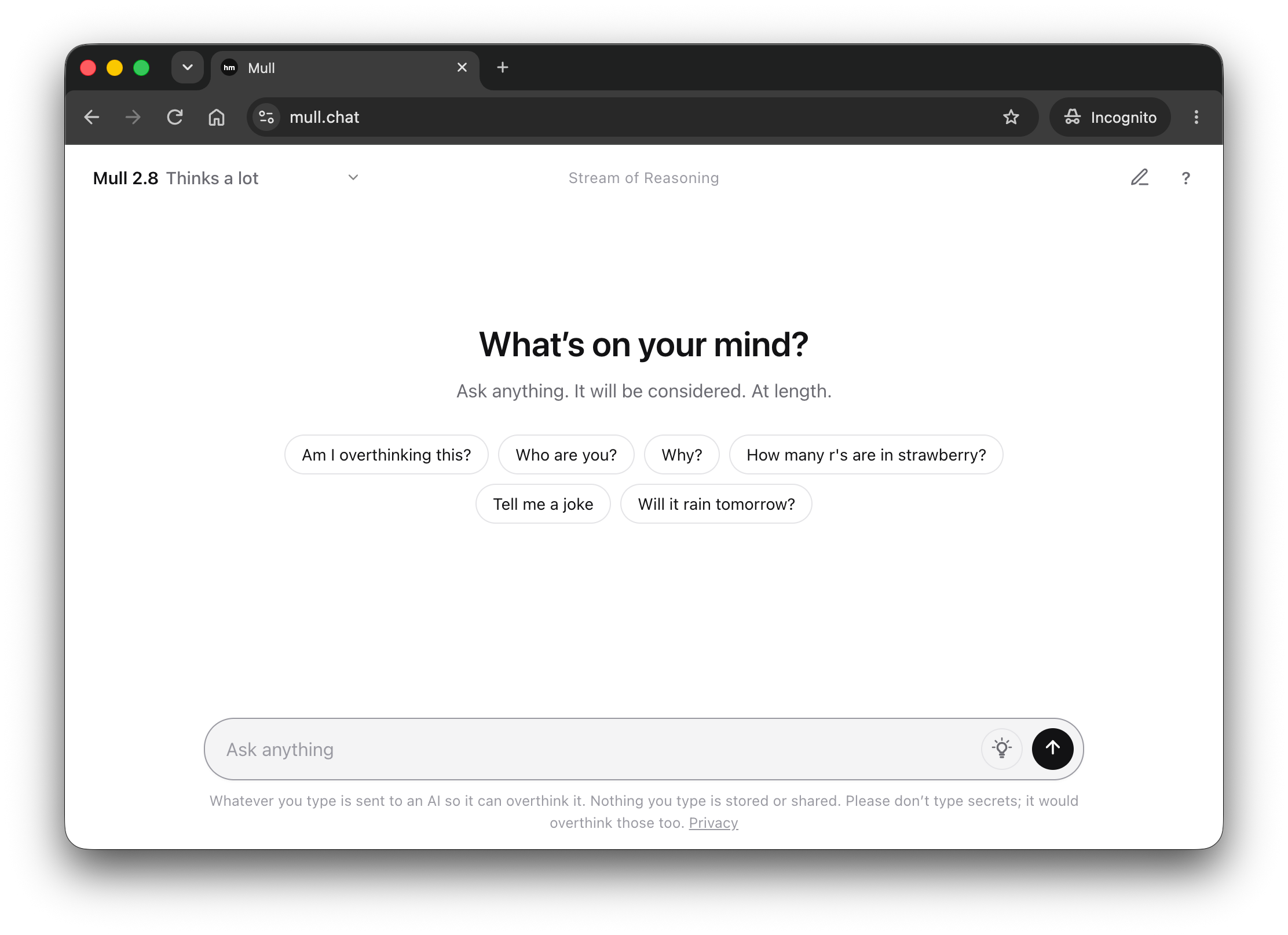
I was in two minds as to whether to post this article. On one hand, it feels a bit self-indulgent. On the other, it is an interesting exercise — and, I think, a worthwhile one — in using play, creativity, and serendipity, to explore how “reasoning” Large Language Models interact with users.12
In the end, I decided to just do it, and let readers vote with their feet as to whether it was worth it or not.
The “self-indulgence” in this case is the reasoning LLM parody website mull.chat. It’s a project that was inspired by the sometimes-bizarre reasoning messages that many LLM-based AIs show users as they mull over how to respond to a question or prompt.
The website — developed with some occasionally ironic help from Anthropic’s Fable 5.1 — started life with me being amused by some of the weirder stream of reasoning messages I was seeing, and idly wondering what a website might look like that parodied these. This quickly grew into a project that got serious about reflecting the performative nature of many LLM stream of reasoning, although at its heart it was always about bringing a smile to people’s faces.3
Rather than explain in pedantic detail what the site does, it’s probably easiest to just try it out for yourself at mull.chat — there’s a quick “cheat sheet” below, but the web page should be pretty self-explanatory:

The reasoning you see on the website is a rather playful emulation of an LLM, and not an actual LLM doing the work (although there is an occasional call to Claude to add an extra later of nuance). It’s intended to make you smile (or grimace) while using it, and also to make you think about what an LLM is actually doing when it appears to be reasoning.
I’m still not sure whether this counts as just a “toy” (in the coding sense), a bit of fun, a commentary on the hollowness of seemingly-powerful AIs, a learning tool to be used in the class and elsewhere, or something else. But it brings me joy, and that seemed a good enough reason as any to share it.4
The link, again, is mull.chat. And if you’re interested in taking a deeper dive, there’s more on GitHub, although as most of this was written by Fable, some of it feels like a parody of itself!
In my defense, much of my work uses play, creativity, and serendipity, to explore new ideas in unexpected and often deeply insightful ways. And despite my tongue in cheek self-deprecation here, mull.chat is a serious part of this. Of course, like humor, such methods — and their results — can be a matter of taste. But that didn’t seem to be a good enough excuse not to share the project.
It’s worth adding that the ASU Future of Being Human initiative’s Guiding Principles include “Obsessive Curiosity,” “Radical Creativity,” “Grounded exuberance,” and “Catalytic Serendipity” — all of which are centra to this project. For more, see futureofbeinghuman.asu.edu/future-of-being-human-guiding-principles, or check out beinghuman.fyi.
It also got rather “meta” as Fable started to parody itself quite delightfully and unintentionally in every aspect of the developing resulting website and the supporting documents.
I find “joy” a deeply under-appreciated metric of intellectual and academic achievement!
So this is what happens when senior professors studying technology go on sabbatical... 😂