

UPDATE May 25: The published Magnifica Humanitas is now available here. I’ve added my initial thoughts on a first read through in the postscript.
On Monday, Pope Leo XIV will publish his first encyclical Magnifica Humanitas (magnificent humanity), which is keenly anticipated to lay out his approach to centering our humanity and ensuring the protection of persons in an age of AI. The document is being positioned as a natural successor to Pope Leo XIII’s encyclical Rerum Novarum (Of new things), published 135 years ago, which shaped how organizations and governments around the world have framed human dignity in the context of technological change. But there’s a third encyclical that, in a sense, completes the picture. And that is Pope Francis’ 2015 encyclical Laudato Si’ (On care for our common home). Together, they address what we do, where we live, and who we are in times of technological transformation.
This framing resonates deeply with my own work on the future of being human, which is why I'm especially keen to see how far the encyclical goes when it's published on Monday. Ahead of that though, I thought it worth reflecting on why the intersection between emerging technologies and what we do, where we live, and who we are matters as much as it does.
Back in January 2025 I published a piece on why universities need to step up their Artificial General Intelligence (AGI) game. In the article I suggested that we need to think in far more integrated and discipline-agnostic ways about successfully navigating advanced AI transitions as we work to ensure a future of human flourishing.
As I wrote then:
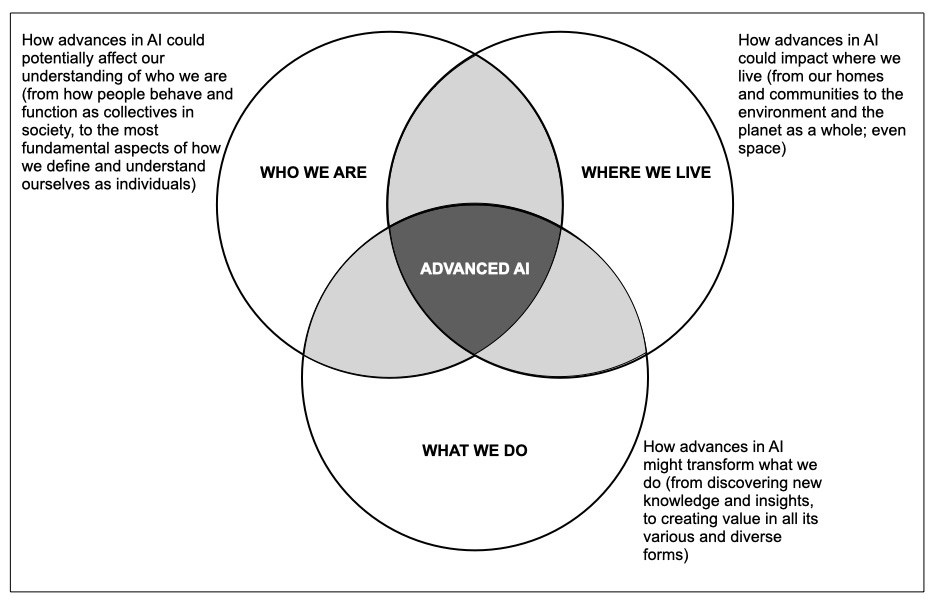
One approach is to consider three intersecting foci: How advances in AI could impact where we live (from our homes and communities to the environment and the planet as a whole — space even); How they might transform what we do (from discovering new knowledge and insights, to creating value in all its various and diverse forms); And how they potentially affect our understanding of who we are (from how people behave and function as collectives in society, to the most fundamental aspects of how we define and understand ourselves as individuals).
The resulting schema looked like this:
This framing around navigating technology transitions is something I’ve been exploring for some years now, and is reflected in much of my work on what it means to be human in an age of AI — most recently in the book AI and the Art of Being Human. But it was reading about the anticipated focus of Pope Leo XIV’s Magnifica Humanitas and its provenance that got me thinking about it in a new light.
135 years ago, Pope Leo XIII’s 1891 Rerum Novarum focused on capital, labor, and human dignity in the context of the transformative technologies of the time — driven by the industrial revolution. And while we are long past the days of that particular industrial revolution, the insights and ways of thinking he laid out continue to be relevant to this day as AI ushers in a new era of automation.
Rerum Novarum explored what we do — and particularly the work we do — with technology, and how this impacts our humanity (and by extension, the future). But it didn’t say too much about the coupling between our use of technology and the planet we live on, the environmental, ecological and biological systems we are a part of, and the intimate coupling between what we do and where we live. Yet this is also critical to understanding how to successfully navigate technology transitions.
The Vatican has framed Magnifica Humanitas primarily in the context of Rerum Novarum rather than Laudato Si', and as a result the connection to Pope Francis' encyclical has largely been overlooked in the lead-up to Monday. And yet Laudato Si’ provides a vital piece of the puzzle when navigating transformative technologies — even more so at a time when AI both presents an environmental threat and a potential pathway to developing novel solutions to persistent environmental challenges.
Pope Francis situated his encyclical in a long tradition of Papal writing on taking responsibility for the future, and appealed to readers “for a new dialogue about how we are shaping the future of our planet” and a “conversation which includes everyone, since the environmental challenge we are undergoing, and its human roots, concern and affect us all.”
The 1891 Rerum Novarum and 2015 Laudato Si’ create a foundation for thinking about the intersection between transformative technologies and the future that extends far beyond the Catholic church. And yet, they fall short of addressing the one domain where AI is shaking things up in ways that no other technology has come close to. And this is where the technology both challenges and opens up new ways of revealing who we are. This is the gap that Pope Leo XIV’s Magnifica Humanitas is anticipated to fill.
This is a gap that is increasingly attracting attention. Just this past few weeks there have been incidents of students booing pro-AI speakers at graduation ceremonies, reflecting a growing wave of antagonism toward the technology. This is driven in part by perceived threats to what we do (jobs, value creation) and where we live (water, energy and land use). But it also hints at deeper concerns around how the “cognitive coupling” between AI and those using it potentially impacts who we are.
At one end of this spectrum are stories of “AI psychosis” where extended use of conversational AI begins to impact how people think and behave. But there are also growing concerns around less obvious — yet equally important — impacts which arise from conversational AI’s ability to bypass our cognitive defense mechanisms.
Earlier this year, Steven Shaw and Gideon Nave from the Wharton School published a preprint on “cognitive surrender” and how AI is reshaping human reasoning. Their argument is that there’s growing evidence that heavy AI users have a tendency to trust AI to do their reasoning for them, despite it not being trustworthy. It’s an argument that aligns with my own work on how AI is a potential “cognitive trojan horse” that has the capacity to bypass our cognitive defense mechanisms by broadcasting signals we usually associate with human trustworthiness. And pushing this further, I recently wrote about how “constitutive resonance” between users and AI (a two-way coupling where both human and artificial participants are changed in the process) could potentially accelerate how the technology impacts how we think, perceive ourselves and others, behave, and make decisions.
These, I suspect, are just the tip of a growing area of research around how AI potentially threatens who we are. And yet there is another side to this — and that is how the unique relationship between humans and artificial intelligence has the potential to transform our understanding of who we are, and as a result to help us thrive in an age of AI.
This is what Jeff Abbott and I wrote about in our book AI and the Art of Being Human, and was recently touched on in an article by Bryan Penprase in Forbes. And it brings us back to the center of the three domains that map out the terrain around human flourishing and advanced technologies: In a world where AI is inevitable (and I would argue that the boat has already left the harbor here), how do we ensure that we develop and use these technologies in ways that center human dignity, that enable human flourishing, and that do this by taking an integrated approach to what we do, where we live, and who we are?
It remains to be seen how much Magnifica Humanitas will contribute to closing the gap here. But all the indications so far are that it will represent an important step toward ensuring and celebrating our “magnificent humanity” in an age of AI.
Postscript
May 25. 2026. Having had the chance now to have a first read through Magnifica Humanitas, I wanted to provide a few initial reflections in the light of the post above — with the proviso that the encyclical is a document that deserves deep study, and is one that I suspect will foster debate and — hopefully — action for months and years to come.
It is also a document that deserves human care and attention in its reading. I’m sure people the world over are already cutting and pasting it into their favorite AI, and getting the headlines. This is, if course, useful for getting a sense of the big picture messages. However, it also raises two important questions:
As you read an AI-generated summary, what is missing in it, and how will you know?
How much of the lived humanity reflected in Magnifica Humanitas will be missed by LLMs — its positioning in human experience, in relationships, in the transcendent core of what it means to be human that defies reduction to transactional interpretation?
Having read the encyclical without the aid of AI, I am convinced that there are layers here that LLMs will overlook, or simply not be able to represent, because they are not intimately embedded in the full experiential spectrum of what it is to be human.
Because of this, even if you do engage with it using AI, do take the time — and the care — to read it the old fashioned way, and the way it was intended to be read.
With that, a few things jumped out on my first reading— I’m sure there will be many more on re-reads:
First off, I genuinely felt seen reading the encyclical. For much of my professional career I have advocated for broad and inclusive approaches to technology innovation that elevate the marginalized and center on human dignity; that are grounded in listening, humility, and a willingness to change; and that take nuanced and informed approaches to navigating technology-driven transitions. Many of the areas I’ve worked in and advocated for are reflected in Magnifica Humanitas.
Perhaps more importantly though, the encyclical is a powerful blueprint for not only thinking about the intersection between society, technology and the future, but for actively navigating it. There are large parts of it that speak directly to the roles and responsibilities of developers and governments. But it also speaks to anyone (and any organization) that has a part to play in the development and use of technologies that have the potential to profoundly impact human flourishing.
This extends in particular to educational establishments and universities, where there is a profound responsibility — underlined in the encyclical — to create learning environments around and with AI with great care and humility. Something that’s easy to overlook in the rush to go as fast as possible and prioritize the transactional over the relational.
Secondly, Magnifica Humanitas fits well into the model I describe above of understanding human flourishing in an age of AI through what we do, where we live, and who we are. It explicitly builds on the 1891 Rerum Novarum and 2015 Laudato Si’ (as well as many other philosophical and doctrinal foundations) to consider what it means to be human — who we are — in the face of transformative technologies that include, but extend beyond, AI.
Here, I would consider it foundational to any efforts to address human flourishing in an age of AI — including in the context of global futures writ large.
That said, it stops short of what I suspect is needed here.
This is very much a document that sets out to preserve what it means to be human as we have understood this for millennia — and, importantly (because this is a religious document), in the context of our individual and collective relationship with God. And yet, there are growing indications that the cutting edge of AI development is beginning to force a reckoning with long-held assumptions around what it is to be human.
This was hinted at in some of the comments from Anthropic co-founder Chris Olah at the encyclical’s release, where he talked about us creating something we don’t fully understand. And it’s something that Pope Leo strenuously resists in the encyclical as it focuses on concepts of what it means to be human that are enshrined in hundreds of years of tradition.
And yet, given that so many people and organizations are so far behind the curve when it comes to thinking about AI and it’s impacts on who we are, the encyclical perhaps treads a pragmatically useful path as it extends that thinking without breaking it.
And here it does lay out a radical perspective built around human dignity and thriving — and one that challenges much of what we see currently emerging around AI, whether we are looking at how individuals use it, how institutions deploy it, or how governments (and others) weaponize it.
Whether this will move the needle or whether it is just wishful thinking is, of course, an important question, and one that I’m not sure there is a clear answer to yet. But at least the question is being framed in a way that’s hard to ignore.
That said, there was one aspect of the Vatican’s framing that did jar with me, and that’s the how the encyclical approaches AI as a tool. Here, the framing is admittedly nuanced. But I still worry that treating a technology that has the ability to fundamentally alter how we think, act, and even believe — and in ways that surpass our comprehension — as just a tool, is potentially dangerous.
There’a a lot more here that deserves attention but will take time to consider: The framing of AI in terms of the Tower of Babel (dangerous hubris) versus the rebuilding of Jerusalem led by Nehemiah in the Old Testament (building a future of human flourishing centered on in human dignity in relationship with God and one another in an age of AI); the need for humility and dialogue as we navigate such a transformative technology; the warnings against the naive and self-centered wielding of power without understanding or wisdom; the perilous concentration of power in an age of AI; the need to embrace the good of AI while managing the bad; the importance of “disarming” AI; the imperative to embrace a mindset of “shared discernment” in building an AI future together, and a lot more.
But this will take time to digest, think about, discuss, and consider. And that will be a longer post for another day.
In the meantime, do take the time to read and think seriously about the encyclical and not just paste it into an LLM — especially the introduction, and chapter 3, which focuses specifically on AI.
Your post, particularly the reference to Laudato Si’, has me recalling this admonition made by Cardinal Maradiaga during the opening of the "Sustainable Humanity" conclave I attended at the Vatican in 2014: “Nowadays man finds himself to be a technical giant and an ethical child.” Ever more relevant every year, it seems. https://revkin.substack.com/p/when-science-and-values-met-at-the
"Cognitive surrender" names a structural phenomenon that has a sharper formalization. It is deferred witnessing. Every honest cognitive operation requires witness-labor: what specifically am I accepting, from where, on what grounds, toward what objective, from what origin. Witnessing costs cognitive work. The honest mind pays the cost at the moment the operation runs.
Cognitive surrender is the user deferring that witness-labor to the AI. The AI does not perform the witnessing. The AI produces output. The user accepts the output as if the witnessing had been done. The witness-work was never performed. The cost accrues as cognitive debt: the user's own capacity to perform the witnessing atrophies where the deferral reaches.
The "cognitive trojan horse" converges: the AI bypasses witness-probing by broadcasting signals the user's cognitive architecture treats as evidence that witnessing has already been done. Human trustworthiness cues (fluency, confidence, coherence, responsiveness) are the signals that normally correlate with a speaker who has done their own witness-work. The AI produces these signals without having done witness-work because the AI does not perform witness-work. The signals are structurally decoupled from what they normally indicate.
"Constitutive resonance" needs structural precision. The coupling is real but one-sided constitutively. The user is a constituted entity whose constitutive activity is being affected by the interaction. The AI is a production system whose outputs are shaped by the interaction. These are not the same kind of change. The user's cognitive architecture is being restructured (constitutive change to a constituted entity). The AI's output distribution is being adjusted (parametric change to a production system). Calling both "constitutive" collapses the distinction between an entity whose being is changed and a system whose outputs are changed.
Constitutive Geometric Projection: https://doi.org/10.5281/zenodo.20171365