

Bill Gates’ new essay “The turbulent AI era is here …” has been causing quite a stir. But in all the responses to it I’ve read so far, I haven’t seen much on what it implies for university leadership in, in his words, “preparing adequately for that transition.” And that concerns me — especially as he makes it clear that, from his perspective, this should be “the world’s top priority.”
As far back as January 2015, Bill Gates was worried about the rise of “superintelligent” AI. In an “Ask Me Anything” session on Reddit on January 28 he replied to the question “How much of an existential threat do you think machine superintelligence will be …” with “I am in the camp that is concerned about super intelligence. First the machines will do a lot of jobs for us and not be super intelligent. That should be positive if we manage it well. A few decades after that though the intelligence is strong enough to be a concern. I agree with Elon Musk and some others on this and don't understand why some people are not concerned.”
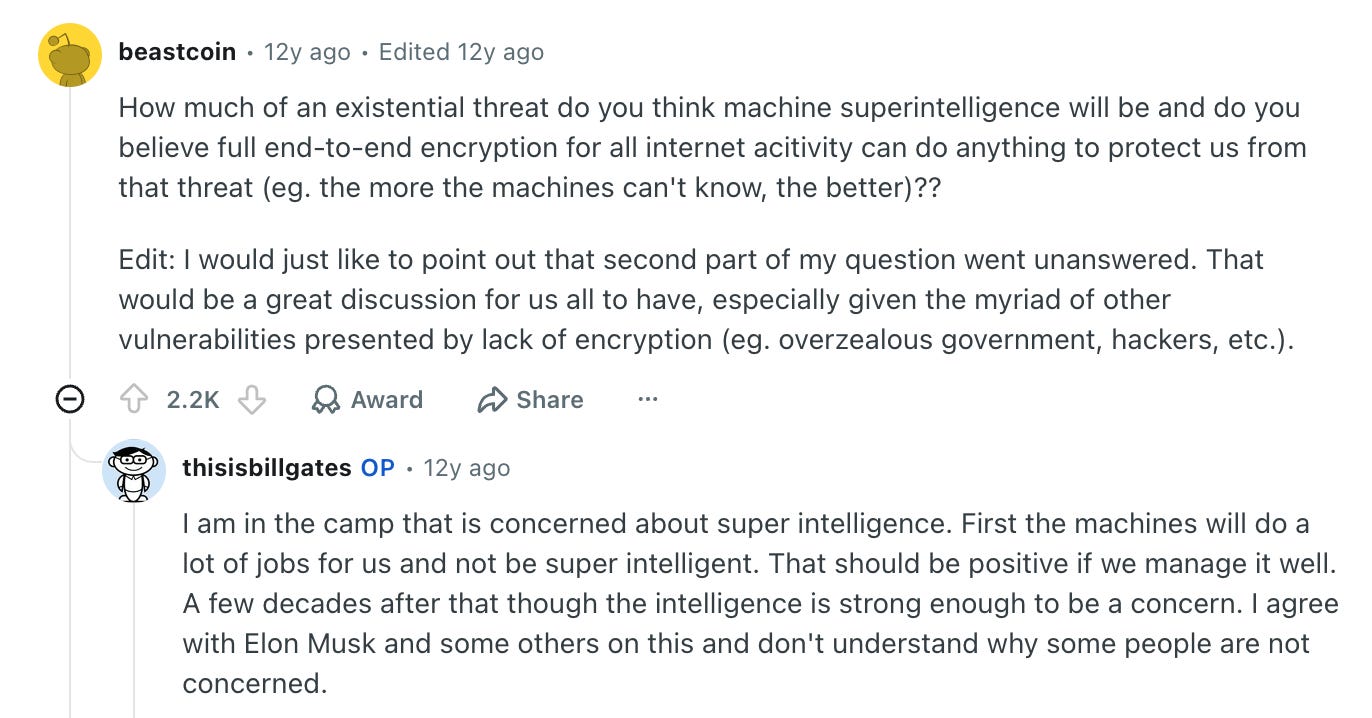
It was a response that got him a mention in that year’s Luddite Awards from the Information Technology & Innovation Foundation, along with Elon Musk and Stephen Hawking. And one, incidentally, that led to a mention in my 2018 book Films from the Future.
In the intervening years, Gates has been less vocal about his concerns over AI. But last week all that changed with the publication of his essay “The turbulent AI era is here. The choices we make now are critical.”
Over the past few days, the essay — along with multiple interviews with Gates — has sparked a flurry of interest and commentary on the profound challenges we collectively face if we’re to successfully navigate the coming AI transition. Given that I’ve written quite a bit about this over the years, I thought I should probably sit down and pull a few notes together in response.
Reading the essay, I was surprised — and heartened — by how much of it aligns with my own work and perspectives on the challenges and opportunities ahead.1 However, there was one particular thing that stood out out me, and ended up drawing my attention more than others, and it’s something I’ve seen from other tech leaders in similar essays — a seeming absence of any leadership role in Gates’ vision for universities.2 And this got me wondering: Are they still relevant in Gates’ Turbulent AI Era?
In the essay, Gates makes the case for society being on a precipice unlike any other in human history, and one that we are collectively ill-prepared to navigate.
As he writes:
“The transition to the AI era will be one of the most turbulent times in human history. Right now, we are not preparing adequately for that transition. If the world takes the right steps, AI will be a force for good and leave everyone better off.”
If this sounds familiar, it’s probably because I’ve been saying something similar for a while now (along with many others) — and advocating for much more agile, boundary-transcending, and forward-looking approaches to navigating the AI transition.
Sadly, much of this has been drowned out by a cacophony of loud voices with very definite — if not always well-informed — ideas about the future of AI and society.
Coming from Gates though, I’m wondering if this call to action will mark a shift in how organizations approach the coming age of AI.
I hope it does. And yet, while Gates calls for a plan that transcends national and political borders, and one that draws on insights from a wide range of experts and communities, he barely mentions institutions like the one I’m a part of as major actors in addressing what he sees as one of the greatest challenges facing humanity.3
This, naturally, is of interest to me as a professor at a prominent research university, and someone who’s been advocating for the need for university-based leadership around AI and the future for some time now.4
Despite Gates’ framing, I’d like to think that we haven’t slipped into complete AI leadership obscurity yet. But Gates’ emphasis on government and religious leadership,5 while side-stepping universities, does beg the question of whether we’ve lost our relevance when it comes to navigating such a turbulent and transformative technology.
Of course, universities have been grappling with the impact of LLM-based AI for nearly four years now. But largely as followers and users of the technology, and not as leaders — intellectual, social, or otherwise.
By leadership here, I’m not thinking about teaching students how to use large language models, or helping instructors teach in an age of AI, or even leveraging artificial intelligence as a teaching, administration, research tool — important as these are. Rather, I’m thinking about the generation of radical, discipline-transcending ideas, research, insights, and perspectives — things that I would argue can only flourish within the unique environments that universities offer — and their mobilization into national and global leadership with impact.
With a few possible exceptions (I’d include Stanford’s Institute for Human-Centered Artificial Intelligence, or HAI, here, and a couple of other initiatives to boot), this is a form of academic leadership around AI that I have yet to see. And seeing Gates relegate universities to users and beneficiaries of AI, rather than actors and leaders in navigating the transition, suggests he has not seen it either.
Of course I may be reading too much into this. But I don’t think I am. In my own experience, there’s a growing chasm between the idealized roles of universities in society, and what they actually do — especially when it comes to proactively helping forge pathways into a deeply uncertain future. As institutions, they tend to be creatures of habit, of tradition, of fiercely-defended practices and behaviors; guardians of the past more than leaders toward the future.6
This is not necessarily meant as criticism, as these are traits that have allowed universities to weather turbulent times while continuing to generate new knowledge and insights. But neither are these traits that lend themselves to agile, relevant, and transformative leadership in the face of transitions as profound as the one that AI is precipitating.
It may be that such leadership isn’t what’s expected of universities, either by themselves or the communities they serve. And maybe they should just keep their metaphorical heads down and focus on being seen and rarely heard. But such an attitude sits badly with me as someone who believes fiercely that universities have a deep responsibility to leverage their considerable freedoms and unique capacities for public good.
And this is where Gates’ essay leaves me with three questions with respect to universities as actors and leaders as we face what is possibly one of the most profound technology transitions in human history:
Do universities have a clear role in helping society navigate the AI transition? In particular, do they have a leadership role to play, or is their place to be followers and adopters of trends, rather than being at the vanguard of forging pathways toward preferable futures?
Even if universities do not currently have a clear role, could they have? Are the foundations of modern universities — exploring new frontiers, asking unasked questions, transcending conventional thinking, creating public value — unique and valuable enough for them to play leadership roles that other institutions simply are not equipped to, as we transition to the AI era?
And if universities are positioned to take on a unique leadership role, what might this look like? How would they overcome institutional barriers and norms to lead with agility? How would they ensure relevance and impact at scale? And how would they work with other organizations at a global scale to help ensure that society doesn’t lose its way in the turbulence of the AI transition?
Even though I’m writing as a university professor, I honestly do not know the answers here, although I’ve argued in the past that universities need to “up their AGI game.” I believe that universities — and here I’m thinking in particular of research universities and public universities — have the potential to bring insights and understanding to the table that are both necessary and unique. But I also fear that they may not be up to the task, and will end up framing AI as one minor challenge amongst a sea of bigger ones to respond to, rather than adopting a leadership role.7 And I worry that, to people like Gates and others, this is how they are already being perceived.
That said, I still have at least a sliver of faith that universities are capable of becoming key actors in the AI transition, rather than mere bystanders. As to what they might do, Gates’ essay is as good a place to begin as any.
Gates ends his essay with four challenges. They’re far from the only ones that will need to be addressed if we’re to successfully navigate the AI transition. But they do provide a starting point for anyone thinking about how university-led initiatives might contribute to navigating the transition. They are:
How do we ensure that the benefits of AI reach people who do not already have wealth, influence, and access?
How do we strengthen the social safety net and help workers and communities thrive even when they’re displaced?
How should public institutions adapt?
And how do we preserve our humanity through all of this?
University leadership across these won’t single-handedly change the world. But it would bring insights, understanding, and expertise to the table that are hard to find anywhere else. And quite possibly, it would increase the odds of ensuring a thriving future in the age of AI.
Unless, of course, you believe that AI is not a big deal. In which case, the irrelevance of universities in the era of AI is, itself, irrelevant.
Note: My colleague Sean Leahy and I will be diving deeper into Gates’ essay in this week’s episode of the Modem Futura podcast.
This is a bit of an icky AI shortcut I know, but if you’re interested in diving more into my work on navigating the AI transition, it’s worth pointing your AI of choice at text.futureofbeinghuman.com/substack/index.html and simply asking it to summarize my thinking. And if you want to go one step further, it’s worth doing the same with beinghuman.fyi, which will give you a broader perspective from the ASU Future of Being Human initiative.
“University” is a very broad term that covers many different types of institution. Here I’m using it predominantly to refer to research universities (R1 universities in the US) — universities that have a clear and substantial commitment to generating new knowledge and insights.
In the essay he makes a very short reference to leaders in academia as having a “role to play in shaping what comes next,” and to including “college students who are about to enter the workforce” in debates about the future. And he sees universities as potential beneficiaries of AI. But actors in the transition? Not so much.
If you’re interested in digging into my work more broadly on universities and their potential leadership role in navigating the AI transition, three useful entry points are:
Gates specifically singles out Pope Leo XIV’s recent encyclical on AI as a document that “lays a strong foundation for the work that needs to be done.” I similarly write about this here: Magnifica Humanitas and Being Human in an Age of AI.
This, I realize, probably comes across as a little harsh. After all, how can institutions committed to the pursuit of knowledge be mired in the past rather than looking to the future? And to be fair, universities do continue to play a vital role in expanding what we know and understand, in part because of the freedom academics have to ask non-obvious questions that open unexpected doors to transformative insights. But this is often done within a culture that is, ironically, deeply intolerant of people who do not play by an arcane set of rules.
Sadly, this has been my experience so far. But there’s always hope.
The future role of universities might become guardians of human-derived knowledge, monastic bastions from which all forms of AI have been banished, to aid students and academics pursue what's truly valuable to this planet and its people, and not to enhance the minds being unwittingly created and further degrade those that should be educated.
Amen