


A couple of weeks ago the US Government announced an audacious plan to “unleash a new age of AI‑accelerated innovation and discovery that can solve the most challenging problems of this century.” Drawing heavily on the promise of AI-accelerated discovery, The Genesis Mission—established by an Executive Order signed by President Trump and led by the Department of Energy—has its sights set firmly on ensuring “America’s technological dominance and global strategic leadership” in an increasingly turbulent world.
The plan is big, bold, and could be a game changer for how science is done in an age of AI. But of course, being a consummate academic, my first question was far more opportunistic: “What does this mean for university funding?”
After all, America’s research universities have long been seen as the engines of innovation that underpin technological progress.
The short answer is not a lot—at least at present.1 But this doesn’t mean that there isn’t room at the table for enterprising universities that are willing to focus more on what they can give to the mission, rather than what they can gain from it.
Accelerating applied research through national labs
Reading through the initial documents that have been released on the Genesis Mission, it is clear that this is intended as an initiative that’s to be driven by the nation’s national labs and through public private partnerships, with universities only getting a couple of passing mentions that feel more obligatory than substantive.
The Executive Order, for instance, mentions combining the efforts of “brilliant American scientists” and “world-renowned universities” with American businesses and existing Federal resources “to achieve dramatic acceleration in AI development and utilization”—but the document primarily places the Mission in the hands of the nation’s national labs and corporate partners (including most of the major US-based AI-forward companies).
The Department of Energy’s Genesis Mission website is a little more specific, noting that the “Genesis Mission brings together the Department of Energy’s 17 National Laboratories with America’s leading universities and industry, including pioneers in artificial intelligence, computing, materials, and energy, to build the most powerful scientific platform ever to solve national challenges.” Yet click on the list of initial collaborators, and all 56 of them are industry partners.
In a Letter to the Community following the announcement of the Genesis Mission, Mission Director and DOE Under Secretary of Science Dario Gil also references university partners, acknowledging the US’ universities as a key pillar of the American innovation system. But again this feels pro forma, with the primary thrust on applied and mission-driven work coming from the national labs and industry partners.2
The result is a sense that there’s a necessary nod to university-based research as it is such an integral part of the US innovation ecosystem, but that the Genesis Mission is far more focused on achieving impact at speed without relying too heavily on universities.
This is perhaps not surprising given the current administration’s very tangible frustrations with academic establishments—frustrations that stretch beyond ideological clashes that attract media headlines, and get to the heart of the perceived value that universities deliver to the American people. And here, there’s palpable discontent around the use of federal funds to support research that doesn’t appear to demonstrably serve the national interest.
Of course, it would be easy to criticize the White House for not prioritizing university funding more overtly in the Genesis Mission. After all, where else will the intellectual fuel for true innovation come from, if not from the nation’s foremost academic institutions?3 But rather than fall back on protectionist critique, I suspect it’s far more useful to take a step back and ask how US universities might bring true value to an initiative like the Genesis Mission, rather than get tied up in knots justifying why they deserve a slice of the funding pie.
Before I get there though, it’s worth taking a step back and considering more closely what the Genesis Mission is and what it sets out to achieve.
A new approach to solutions-focused science
The Genesis Mission was launched on November 24th as (to paraphrase the Executive Order) a massive coordinated national effort focused on dramatically accelerating scientific discovery, strengthening national security, securing energy dominance, enhancing workforce productivity, and multiplying the return on taxpayer investment into research and development—all with the aim of furthering America’s technological dominance and global strategic leadership.
To achieve this, the Mission sets out to combine vast data reserves covering decades of federally funded research with advanced AI models, high performance computing, and cutting-edge quantum technologies—all with the intent to, in the words of Dario Gil, “double the productivity and impact of American science and engineering within a decade (and in half that time across our National Laboratory complex).”
Just let that sink in for a moment: The aim here is to leverage massive federal data reserves, AI, massive compute, and even quantum technologies, to double science and engineering productivity and impact across US National Labs within 5 years.
That is one audacious aim!
Within this, the Genesis Mission explicitly encompasses transformative breakthroughs in fields closely coupled to national security and global technological dominance that range from advanced manufacturing and high performance/critical materials, to new energy sources and cutting-edge molecular medicine. And to achieve this it sets out to massively leverage resources within Federal labs, all while drawing on industry partnerships and following highly efficient research strategies that are focused on very specific outcomes.
In other words, this is an initiative that is committed to speed, efficiency, and impact, with little tolerance for collaborations that may hold it back.
And in an administration that’s already questioning the value of university-based research, I suspect that university funding is in danger of falling, at least in part, in this latter category.
Yet despite this, my sense is that universities do have considerable value to bring to the Genesis Mission, as long as their leadership and researchers are willing to think critically and creatively about what they have to offer, and what they do not.
Rethinking the academic value proposition
So how might universities bring value to an initiative that seems, on the surface at least, not to need them?
One thing’s for sure: simply claiming that universities deserve to be part of the Genesis Mission from a position of entitlement is not going to fly. Rather, I strongly suspect that there will need to be some willingness to examine where the academic value proposition is weak, and explore ways to genuinely strengthen it.
Admittedly, this will be tough given that academia has a long and illustrious tradition of moving slowly, being caught up in its own sense of self-importance, and having a tendency to deliver on what researchers think is important, rather than what the organizations funding them actually want.
That said, I believe that there are opportunities here for universities that are willing to ask how they can contribute, rather than simply what they can get out of the Genesis Mission.
So what might these look like? There are, of course, many possibilities here. But I did want to present just three that, together, could form the beginnings of a Mission-aligned partnership strategy:
1. Research and scholarship that supports high speed/high serendipity discovery
The Genesis Mission is all about speed. But within research circles there’s often an intuitive sense that going fast makes it harder to create the space for those unexpected discoveries that so often lead to transformative steps forward.
In other words, it can often feel that there’s a tension between speed and serendipity.
As it turns out, this is an oversimplification. But the framing of serendipity and speed as two factors that are important to the success of the Genesis Mission does provide a useful illustrative model for exploring where universities may bring value to the initiative:
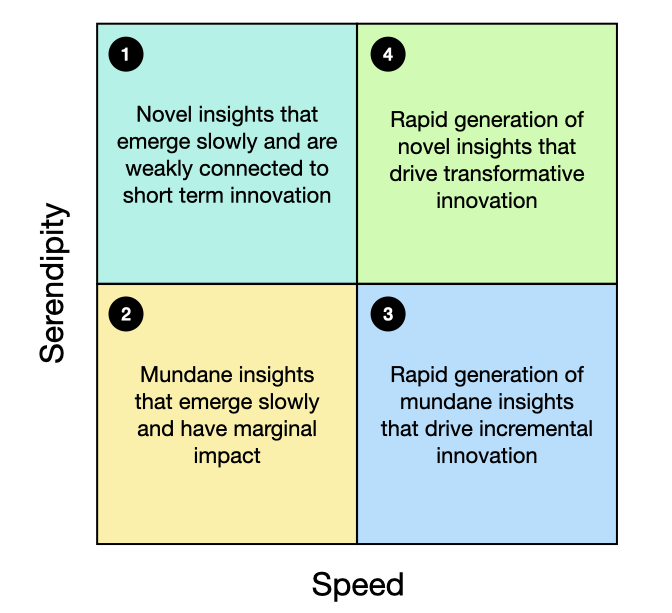
By considering four domains of discovery associated with serendipity and speed, it becomes possible to identify where the Genesis Mission ideally needs to be situated to succeed, where it potentially lands without strategic input from universities, and what it might take to get it to where it needs to be.
Quarter 1 of the matrix—highly serendipitous but slow rates of research—is most often associated with academic initiatives. As it turns out this isn’t exactly true, and a growing body of work is showing how serendipity can cut across different research environments (for instance Ohid Yaqub’s 2018 paper on a taxonomy and theory of serendipity is highly recommended here.4) Yet “slow with a promise of serendipity” remains an approach to knowledge generation that continues to be synonymous in many people’s minds with leading research universities.
In contrast, quarter 3 of the matrix—high speed but not very serendipitous research—tends to be more closely associated with industry and government labs. Again, the mission- and outputs-driven research associated these labs can be serendipitous. But it’s not unusual to find the freedom and flexibility necessary for unexpected discoveries to be curbed in the name of efficiency.
Compared to these, quarter 2—low speed and not very serendipitous research—is where no-one wants to be, but is where I suspect a lot of federally funded research ends up. This is a quadrant where research is constrained by grueling grant-cycles, overbearing bureaucracy, and the need to deliver on performance indicators that don’t necessarily align with fast and creative discovery.
Then we have quarter 4—high speed and highly serendipitous research. This is where the Genesis Mission aspires to be. It combines the speed of discovery associated with commercial labs, with the step-change breakthroughs more usually associated with academia. Yet this is a highly elusive quadrant, and one that there’s no guarantee that the Genesis Mission will inhabit—simply because resources and ambition alone do not automatically lead to serendipity and speed.
The good news for the Federal Government is that we know it’s possible for private and government-led research initiatives to exist in this quadrant. Bell Labs, DARPA, the Apollo Missions, and the Manhattan Project, are all good examples of success stories here. But these are not the norm. To intentionally and efficiently move the Mission from quadrant 3 to quadrant 4 needs theory and understanding on how this might be achieved—especially where emerging technologies like AI and quantum tech are being leveraged.
And this is where university-based research and scholarship potentially comes into its own. While universities may not be able to compete with national labs and commercial initiatives on speed, they excel at developing new theories and models—especially where these benefit from insights and methods that transcend traditional disciplinary boundaries. And I suspect that this is a research domain where slow speed but high serendipity research—quadrant 1 research—could be influential in informing and catalyzing transitions from quadrant 3 to quadrant 4.
2. Learning and education pathways that support high speed/high serendipity enterprises
While new research into how to better-enable targeted high speed/high serendipity research is necessary, there’s only so far that it can go without new findings being translated into new skills and practices. And for this to happen, there will need to be new learning and education opportunities and pathways.
This is important generally for supporting transitions from quadrant 3 to quadrant 4 in mission-driven research. But it is likely to be vastly more important around efforts to leverage AI- and quantum-enhanced discovery, as these take us into uncharted territories for which no robust learning and education pathways currently exist.
And here it’s hard to imagine how any institutions other than research universities could fill this need. They already form the backbone of higher education in the US. And as a result they have a unique capacity to translate cutting-edge research into cutting-edge education and learning.
Given this, I would argue that universities have a unique and critical role to play in equipping scientists, engineers and technologists engaged in the Genesis Mission to accelerate mission-driven and high-value research and discovery—especially where this involves accelerating research through leveraging emerging AI and quantum technologies.
3. Pivoting to new university models
Given the somewhat peripheral potential role of universities in the Genesis Mission as it’s been articulated so far, maybe it’s time to re-examine what they bring to the table.
This is, of course, a rather contentious suggestion, especially given the central role of research universities in the US’ innovation enterprise over the past 80 years. Yet it’s one that needs to be taken seriously as the Genesis Mission indicates increasing movement away from the post-World War II model of the research–innovation pipeline established by Vannevar Bush.5
I’m not sure that the national labs-focus of the Genesis Mission is sufficient on its own to justify exploring new university models. But if this is taken as one of a growing number of indicators that research universities are out of step with societal expectations, at the very least it behooves them to pay attention.
This, of course, is not new news in the US. Alongside the current administration’s heavy-handed “re-evaluation” of research funding strategies and priorities, there’s been growing introspection amongst academic institutions and leaders for some time around how universities might better-align with societal perceptions, expectations and public-oriented value-creation. And this extends to ensuring that research more clearly benefits—or is understood to benefit—national goals and priorities.
There are, of course, complexities and nuances here. There remain compelling arguments for research enterprises that are insulated against the ever-changing whims of political expedience and public opinion, and that are designed to deliver long-term public benefit through research that’s driven by curiosity, a love of discovery, and the freedom to ask “why,” “how,” and “what if”—without necessarily knowing where they’ll lead. This is how serendipitous discoveries are often made, how the limits of understanding are expanded in unexpected ways, and how the solid foundations for future research are laid.
But there is no reason why universities cannot also explore how they might move closer to quadrant 4—or even from quadrant 2 to quadrant 4—in the serendipity-speed matrix, by adding greater speed and relevance to academic research initiatives.
Perhaps not surprisingly, this reflects initiatives that are already taking place within some institutions. Anyone who’s familiar with my own institution—Arizona State University—will recognize something of ASU’s redefining of the “New American University” here (although ASU’s ambitions lie far beyond simply reimagining the research enterprise). Yet given the sea-change in research and discovery that AI is ushering in, together with the potential importance of initiatives like the Genesis Mission and broader discontent over the value of university-driven research, now would seem to be a good time for more creative thinking around what a public-serving research university might look like.
For instance, do emerging AI models and capabilities open up new opportunities for research universities to combine serendipity and speed? Can AI be leveraged as a serendipity-accelerator by scientists? How feasible is it for universities to spin up their own versions of the Genesis Mission—AI research labs that synergistically feed off human ingenuity and machine intelligence? Are such AI research labs limited to certain domains of discovery, or could universities forge new pathways into domains that transcend conventional disciplinary boundaries? And could such initiatives become valuable partners in enterprises like the Genesis Mission and beyond?
All of this feels possible, as long as there’s a willingness within universities to pivot away from convention and tradition, and toward institutional structures and missions that respond to shifting expectations and emerging possibilities.
The question is, is the will there—and the impetus—to change?

And this brings us back to where we started: is there a place for research universities in the Genesis Mission? I have to believe there is. But it’s far from guaranteed. Rather, it’s up to universities—and more explicitly their leadership and members—to find and articulate the value they potentially bring to the table, rather than assume it’s a given.
Because, at present, I’m not sure it is.
It’s worth noting that, while currently available information highlights the central role of National Labs and Federal facilities and resources, it’s possible that in the future, funding opportunities will arise through the DOE and other mission-driven agencies, and even possibly key research agencies such as the NIH and NSF. However, a pragmatic read of the current landscape would indicate that universities will need to clearly demonstrate how they will substantive contribute to the Mission—along with clearly articulating mission-critical returns on investment—if they want to position themselves as partners and collaborators.
As an aside, I would highly recommend reading Dario’s letter. In an administration known for its political posturing in official documents, the letter is a breath of fresh air—authentic, visionary, inspiring, and one that brings people together toward a common purpose rather than dividing them.
I am, of course, being more than a little tongue in cheek here.
Ohid Yaqub (2018) Serendipity: Towards a taxonomy and a theory. Research Policy 47 (2018) 169-179. DOI: 10.1016/j.respol.2017.10.007. Yaqub identifies and describes four distinct typologies of serendipity: Targeted research that solves unexpected problem (Walpolian serendipity); targeted research that solves the problem-in-hand via an unexpected route (Mertonian serendipity); untargeted research that nevertheless solves an immediate problem (Bushian serendipity, after Vannevar Bush, not GW Bush); and untargeted research that leads to solutions to later problems (Stephanian serendipity). These cover the gamut of curiosity-driven to mission-driven research and discovery.
Vannevar Bush’s seminal 1945 report Science: The Endless Frontier established the so-called linear model of innovation that placed federally funded basic research carried out by universities at one end of the spectrum, and applied research in federal labs and industry at the other. And while the model has been challenged and transformed over the years to recognize the complex and multidimensional relationship between open-ended and outputs-driven research, it’s still implicitly embedded in many university models.
Great article Andrew - very interesting views!
For those interested in the topic, in my latest piece, The Genesis Mission, I supplement this view by examining why the U.S. has revived the institutional architecture of the Manhattan and Apollo programs, and how this will reshape scientific discovery, the global balance of power, the AI race with China, and Europe’s eroding competitiveness.
This is the new map of power. And it’s being drawn right now.
https://alphawavess.substack.com/p/the-genesis-mission?r=2gkbpg&utm_campaign=post&utm_medium=web&showWelcomeOnShare=false
If we look at advances in most areas of artificial intelligence, the national labs have been almost entirely absent. Confined by narrow definitions of "mission", their focus has been on translating advances from universities and industries into adoption by the armed forces and the intelligence community.
Transforming them into risk-taking hubs of basic research and rapid innovation will require less rather than more mission focus. It will require empowering individual scientists to pursue the directions they believe will be most important. It will require reducing the barriers to the movement of people from industry into/out of the labs.
It may also require hiring different kinds of researchers who are willing to operate outside their comfort zones. Personnel is policy.
One reason universities are able to respond rapidly to new challenges is that every year an entire new cohort of students arrives (and another leaves). Another strength of research universities is that professors, in their teaching role, revisit the fundamentals every year. In so doing, they uncover the cracks and gaps that suggest fundamentally new research directions. Neither the national labs nor the tech companies are forced to think about these questions.