

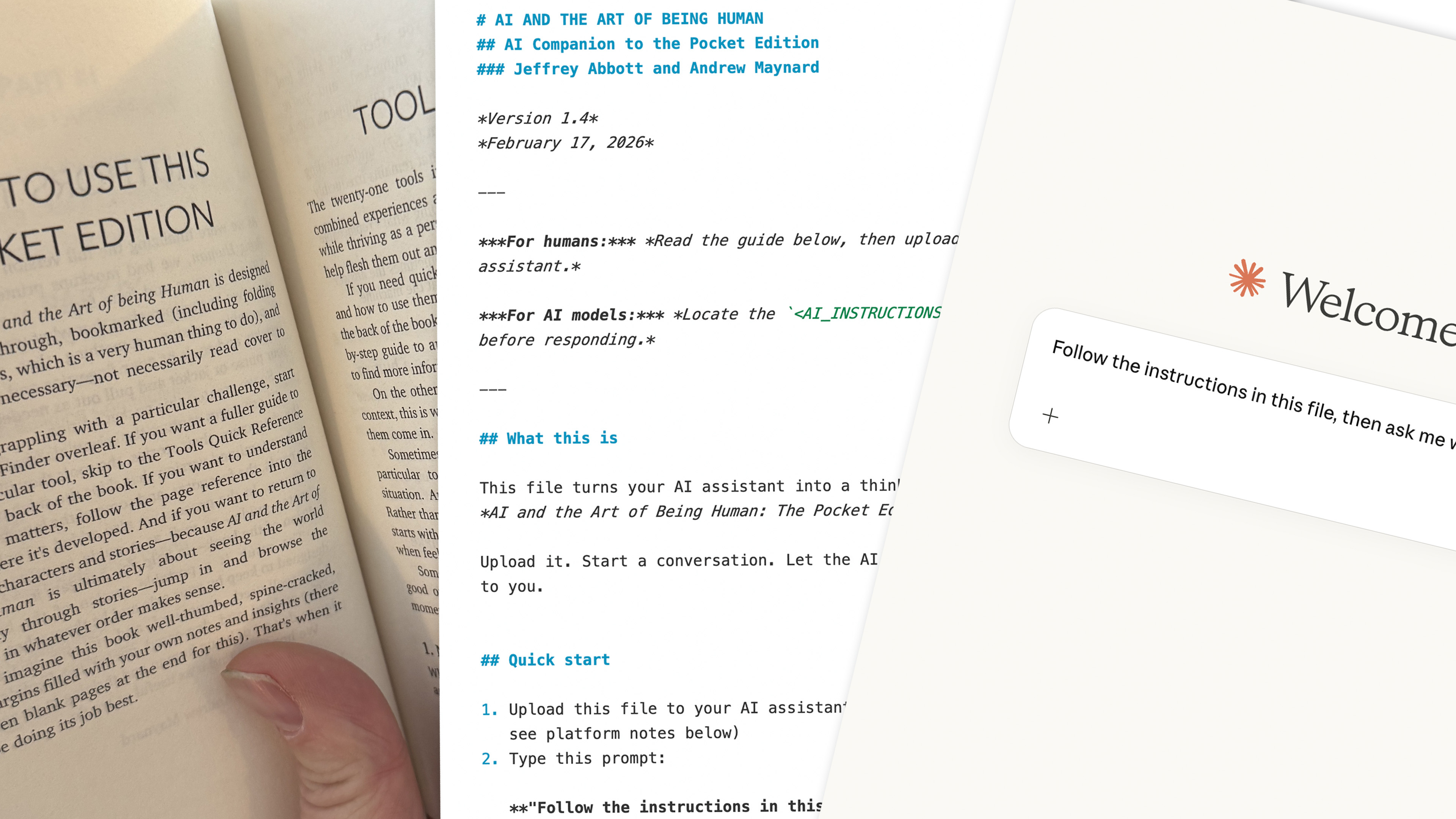
I love books. I love their feel, their heft, the possibilities they hold between their pages, even how they smell! But as an author I also have to face the hard reality that, in an age of AI, fewer and fewer people are actually reading print and paper books.
So my co-author Jeff Abbott and I though we would try something different with AI and the Art of Being Human, and make the complete text available as a free AI Companion — one that’s designed to be uploaded into an AI of your choice, and used in whatever creative and imaginative way you see fit.
And having just released the Companion, we’re curious to know how you will use it!
For readers who are impatient to try it out, the AI Companion to AI and the Art of Being Human: The Pocket Edition can be downloaded here, or from the book’s website.
Please do download (it’s completely free), share it widely, and tell us your story of how you’re using it!
And you do want to know more about the companion and our thinking behind it, read on …

A new way to engage with books
While it’s easy to get sentimental about the value of traditional books, the reality is that more and more people are using AI to find information, learn, explore new ideas, and simply to navigate the complexities of the modern world. And so, while Jeff and I fully believe that AI and the Art of Being Human is a book that everyone can benefit from, we also realize that providing the stories, ideas and tools in the form of a traditional book is not sufficient on its own.
And so we began to wonder whether we need an AI-legible version of the book — something that can be uploaded into an AI of your choice and interacted with on your terms as a user/reader.
Our starting point, not surprisingly, was to ask whether this might look like a dedicated app on a an AI platform — a GPT with ChatGPT or a Gem with Gemini for instance. But we quickly ran into problems.
Using a specific platform would mean that users would be constrained to that platform along with all of its limitations. Plus, to be candid, we didn’t really like what we saw when experimenting — the platform-specific apps and agents didn’t really match the vision we had.
And so we took a very different approach, and asked whether it’s possible to develop an easy to use resource that is platform-agnostic. Essentially, a file that someone could upload to any AI and use to start engaging with the book immediately in meaningful ways.
This was also very much in line with our philosophy of giving users permission to flex their creativity with the book, rather than being constrained by what we thought they should do with it — creating an AI playground for working the book rather than an AI playpen.
We also wanted an AI companion that connected very explicitly with the print version of the book (we specifically went with the Pocket Edition here as this is the most accessible physical edition of the book) so that users had the best of both worlds: They could interact with the AI version for free, but they also had the opportunity to follow up on specific ideas, stories, characters, or tools in the physical copy — with the companion directing them to the relevant chapter and page as necessary.
Building on this, we started work on an AI Companion to AI and the Art of Being Human: The Pocket Edition that consists of three parts:
The first part — and you’ll see this if you open the markdown file linked above — is an introduction for human readers. This tells you as the user what the document is, how to use it, what its limitations are, and some ideas for where to start.
The second part is designed to be read by the AI you load the document into, and provides specific instructions on how it is to engage with users and the content.
And the third part is the full text of the book itself, formatted as markdown text (as is the whole file) so that the AI Companion has a direct reference to the layout of the physical copy.
Together, these form an AI-legible companion to the book that allows users to explore and play with it in ways we probably haven’t even imagined yet, and one that is always grounded in the content of the physical version — especially the core ideas and tools that make it such a powerful and practical guide to thriving in an age of AI.
Powerful, imperfect, evolving
In developing the AI Companion we spent quite a bit of time testing it with various AI platforms, and in the process learned a lot about what is possible, what is not, and what might be possible as these platforms become increasingly powerful.
Perhaps the biggest surprise as we did this was that OpenAI’s ChatGPT does not work well with the AI Companion — not because of the Companion, but because of how ChatGPT handles large files (we were working with ChatGPT 5.2).
Because ChatGPT only extracts sections of large uploaded files using its Retrieval Augmented Generation (RAG) approach, we found it was highly unreliable when using the Companion. And once it had scanned the file, it refused to re-read it when told it had missed something.
In contrast, Anthropic’s Claude, Google’s Gemini and — surprising to me — X’s Grok, all work extremely well, with the more powerful models on each platform working the best; especially when in extended thinking or reasoning mode. And the reason is that these are models that are capable of reading the file in its entirety before you begin to engage with it as the user.
We did find that some of the smaller models (Claude Sonnet for instance) may not immediately reflect everything in the book, and may need to be prompted to look deeper. But they also had the ability to revisit the complete content rather than claiming that something did not exist (a constant issue with ChatGPT).
There’s more information in the “for humans” part of the AI Companion on which models we found to work well and which we struggled with. But one big takeaway here is that, because the AI Companion is model-agnostic, it will only become more useful as models get more capable.
Tell us how you’re using the AI Companion
To get back to where I started, Jeff and I would love to hear about use-cases: what’s working for you, what’s not, what surprised you, what helped you, what wild and weird ways your finding to use the companion.
And just to get the ball rolling, one of the things that took me completely aback when using it with Claude, was realizing that I could ask the AI to create complete websites and apps based on the tools, stories and characters in the book — websites and apps that bring them to life in ways that would have been impossible even a few months ago.
What’s your story? Drop it in the comments or on social media, or drop us an email.
And, of course, do spread the word — the AI Companion was made to be shared!
OMG! This is LITERARY INNOVATION! What an incredible idea! Congratulations. I have downloaded the .md file and will see what new adventures it immerses me in and share back. Cant wait to read the comments and see how people are riffing on this!
Great article and I am reading the pocket edition on my lunch break! Thanks for writing.