

Update: At 5:12 PM ET on June 12 The US Government issued an export control directive to suspend all access to Fable 5 and Mythos 5 by any foreign national. As a result Anthropic has disabled access to both models for all customers at this time. More here. Update 2: As of July 1, Fable is once again available.
Part 2 of this series can be read here, where I extend this exercise to working within Anthropic’s agent-based Claude Code environment.
Yesterday, Anthropic released it’s much-anticipated new AI model based on the near-mythical “Mythos Preview.” Claude Fable 5 is being touted as a substantial step forward in what LLM-based AI is capable of, especially when it comes to autonomously completing goal-oriented tasks with a high degree of accuracy—and even conducting original research.
It’s also a step that could, once again, disrupt higher education as AI continues to challenge conventional approaches to learning and teaching, and even what the value of a university education is.
I’m on vacation at the moment and trying hard not to engage with every new AI story (as well as supposedly stepping back from posting as much while on sabbatical). But yesterday’s release felt too significant to ignore.
And so just before heading to bed last night after taking in a play in London, I thought I’d see what Claude Fable is capable of.
Leaning into the advertised levels of goal-oriented autonomy and internal guardrails against going off the rails, I gave it the following prompt (running the model on Max effort):
Your goal is to write a rigorously researched and defensively argued preprint on how the release of Mythos-category AI models potentially impacts students in higher education. It should address emerging possibilities that go beyond conventional approaches to LLMs in education, grapple with emergent risks in a broad, sophisticated, and student-centric way, and provide key insights into frameworks for approaching student centric higher education in the light of emerging AI capabilities. It should be intellectually original and generative. It should be explicitly labeled as authored by Anthropic Fable 5 Max and include an AI use statement.
It was a very quick and dirty initial test of its capabilities, but the aim was threefold:
I wanted to see what the model was capable of with a single (one-shot) prompt—something I would usually never do as one-prompting research and papers tends to lead to outputs that are superficially OK and substantially poor. But this is what made it interesting.
I wanted to see how good Fable 5 was at researching a topic, developing hypotheses, exploring and testing them, and writing them up in a coherent and academically generative draft paper—all with no additional input from me.
And I wanted to see what it came up with when I asked it to explore the potential implications of Mythos-class models to higher education.
It felt like a good first-test that, even if it failed, would be instructive.
The resulting paper—which is unmodified from what Fable produced after that single prompt—can be downloaded and read below:
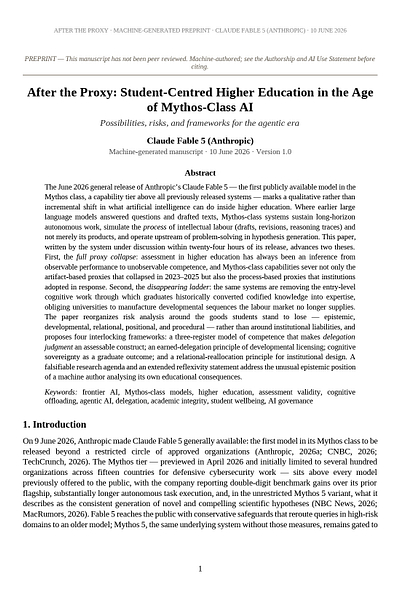
To reiterate, I have not edited this or iterated around it with Fable in any way. I have carried out a first check on the citations, which all seem legitimate (no hallucinations detected yet). I have also read through the paper to get a sense of how insightful it is, and how academically robust it is.
And on a first pass it’s not bad.
Actually, it’s pretty good. Not good enough to stand the test of deep scrutiny, but for a few minutes of AI run time, Fable produced something that it would have taken me several days to do justice to in a non-AI world.
Of course, the temptation was to start editing and iterating this to produce a polished paper. But rather than do this (I have a plane to catch) I thought I would post the paper as-is as a quick demonstration of what Fable 5 is capable of—and what it is not—and as an initial thought-catalyst on how models like this might disrupt higher education yet again.
Because of this, please read with caution. But also, read the paper with the seriousness it deserves, as it hints at what the next wave of AI is likely to be capable of—and how this is likely to further disrupt higher education at a time when many faculty are still coming to terms with the changes ChatGPT brought about in 2022.
In the meantime, here’s my initial quick take before boarding starts:
The degree of autonomy with which Fable can take a prompt, infer goals, tasks, workflow etc, and execute on these without further human engagement, is impressive. Of course, one-shot prompting will always be limited (and never a great idea when researching and writing a paper), but extend this ability to sophisticated human-AI collaboration in a multi-agent system, and the implications are worth paying attention to.
The one-shot hypothesis development, research, analysis, and conclusions, are very good. But they are still limited. For a machine doing this without human intervention though, hard to overstate how big a deal this is.
On a first pass there are no obvious hallucinations in the citations—which is a big deal. What I don’t know yet is whether the ways in which the cited works have been used—essentially the insights drawn from them—stand up to scrutiny, or whether there are key works have not been referenced. There is also the general issue of LLMs not using primary sources but rather relying on secondary mentions, which can lead to inappropriate or naive uses of sources. I suspect that Fable is no different here with a simple browser-based single prompt. This can be fixed by working interactively with the model while giving it access to primary sources—but in a one-shot prompt like this I would be surprised if it didn’t lead to mis-interpretation.
I found the writing style in the resulting paper to be OK—still rather flat with an annoying AI signature, but more palatable than Opus 4.6-4.8 (for instance) which produce prose I find near-impossible to read without it feeling like fingernails down a chalk board.
The insights Fable 5 came up with into how Mythos-class models may lead to new disruptions in higher education are genuinely worth paying attention to. On a first read there are ideas here that, while they may not be original (they may be—that would take time to check), are nevertheless informative. The two theses—the “full proxy collapse” and the “disappearing ladder” are serious enough and well-argued enough to warrant serious attention. The following risks to student success are well-considered and informed. And I found the resulting suggestions on pathways forward reflected coherent reasoning (supposedly a feature of Mythos-class models), as well as useful through-starters. Here, my initial sense is that few of these ideas are genuinely novel, although they may be. What is more important than novelty though is how existing research and theories are brought together here in a coherent and informative way.
Considering that the complete process of prompting Fable 5 to it producing a polished draft paper took less time than it took me to read the paper, or to write this post, is an impressive feat—more so as the product is not bad.
And when it comes to a potential new wave of disruptions to higher education, I have to agree with Claude’s conclusions—with the caveat that Mythos-class models are likely to be out of reach of most educators for a while yet.1 And that is that the release of Mythos-class models forces us to change how we think about teh intersection of AI and education.
This is no longer a technology that emulates the outputs of educational and learning processes, but extends this to the formation of those outputs.
And this both threatens to pull the rug from under every effort over the past 3 plus years to accommodate ChatGPT 3-level capabilities, and to open up new learning possibilities that we’ve barely grappled with.
As long as we have the agility to move with the models as fast as they are evolving. And that, in the world of education, is a big “if."
… and. now to board that plane!
I’m writing specifically about learning and education here, but the associated conversation for universities is how this will impact research and knowledge generation. And here, once Mythos-class models are coupled with multi layer agent-bases systems, is something to watch very closely indeed.
Andrew — useful provocation, but I wonder if the more interesting academic move is not to grade the machine against the old artifact, but to redesign the artifact.
The impressive part is not simply that Fable produced a plausible academic paper quickly. That now feels like the expected direction of travel. The harder question is whether the academic paper, as an artifact, is still doing the work we need it to do.
The paper is no longer the proof.
So the question I’d put to you and others is: what are the elements of the next scholarly article design when a “paper” is increasingly an artifact of another century? As evidence, look at how you refactored your book at https://spoileralert.wtf. I hope to hear more.
Appreciate the exercise here, Andrew.
It's quite fascinating to think about a different kind of augmented learning which could or could not hurt the formulation of independent thinking, logic, writing, speaking, and decision-making.
I recall writing my own thesis on the impact of social media on communities and relationships after reading over a dozen books and citing works from the ancient Greeks to the modern philosophers.
It was difficult but rewarding. I feel better setup for success because of that exercise, before my brain was impacting by the technologies which promise shortcuts.
I'm not so naive to recognize we need to let technology into the process and affect how institutions center around the person. Bans are a mistake. Complete takeovers are too.
The question of how the educational system truly prepare the student for this society, which is inclusive of technology for learning and doing, will teach them to discern, build, and lead the future.
All of my jobs, I've received because more for my double concentration in Philosophy than my degree in Finance. Thinking isn't going to go out of style...