

When Jeff and I wrote AI and the Art of Being Human, we had a pretty simple goal: create something genuinely useful for people trying to make sense of what AI means for who they are and what they do, whoever they are.
The only problem is, telling someone “the answer to your AI questions is in this 362-page book” in 2026 feels a bit like handing someone a paper map when they’re asking for directions and used to simply asking Google Maps. So we decided to do something a little different.
Books still matter of course. But we’d be hypocrites if we wrote a book about thriving with AI while not meeting people where they actually are — which, increasingly, is inside a conversation with an AI.
So we’ve done something that might seem counterintuitive for two authors who would quite like people to buy their book: we’ve made the entire text freely available in two AI-readable formats:
The AI Companion — which I wrote about the other week — is a Markdown version of the Pocket Edition of the book. Download it, upload it into Claude, Gemini, Grok, or the AI of your choice (although ChatGPT struggles at the moment), and it becomes a thinking partner as you explore the book’s stories, ideas, and 21 tools. No app. No platform lock-in. Just a file and whatever you want to do with it.
The Instructor Guide is new. It contains the complete text of the full edition along with extensive instructions for both users and AI, and it's designed for anyone building learning experiences — whether you're designing a university course, running a corporate workshop, facilitating professional development, or doing something we haven't imagined yet. Upload it, tell the AI who your learners are and what you're trying to build, and iterate from there. Think playground, not playpen.
Both are free. And both are designed to be shared.
But why give the book away for free?!
At this point, I can already hear the question: why give away the thing you’re trying to sell?
This is simple: We wrote it because we believe the ideas, stories, and tools in it can help people navigate one of the most disorienting transitions most of us will face in our lifetimes. And if making the content available in ways that let more people engage with it on their own terms means more people actually use it — that matters more to us than gatekeeping it behind a price tag.
We also have a sneaking suspicion — backed by zero hard data and considerable optimism — that people who engage with the book through AI will want to pick up a physical copy. There’s something about holding the stories and tools in your hands that a chat window can’t quite replicate. At least not yet.
So: download them, share them, play with them. Use the AI Companion to explore what the book’s 21 tools mean for your life. Use the Instructor Guide to build something for your students or team that we couldn’t have anticipated. And tell us what happens — we’re genuinely curious.
Some things to try with the AI Companion:
Tell the AI what you’re dealing with right now — at work, at home, in your head — and ask which of the book’s 27 characters faced something similar. Then explore what they did — and argue with it.
Describe a real decision you’re wrestling with and walk through the Stress-Test Table or the 7-Minute Clarity Pause with the Companion, using your actual situation — not a hypothetical.
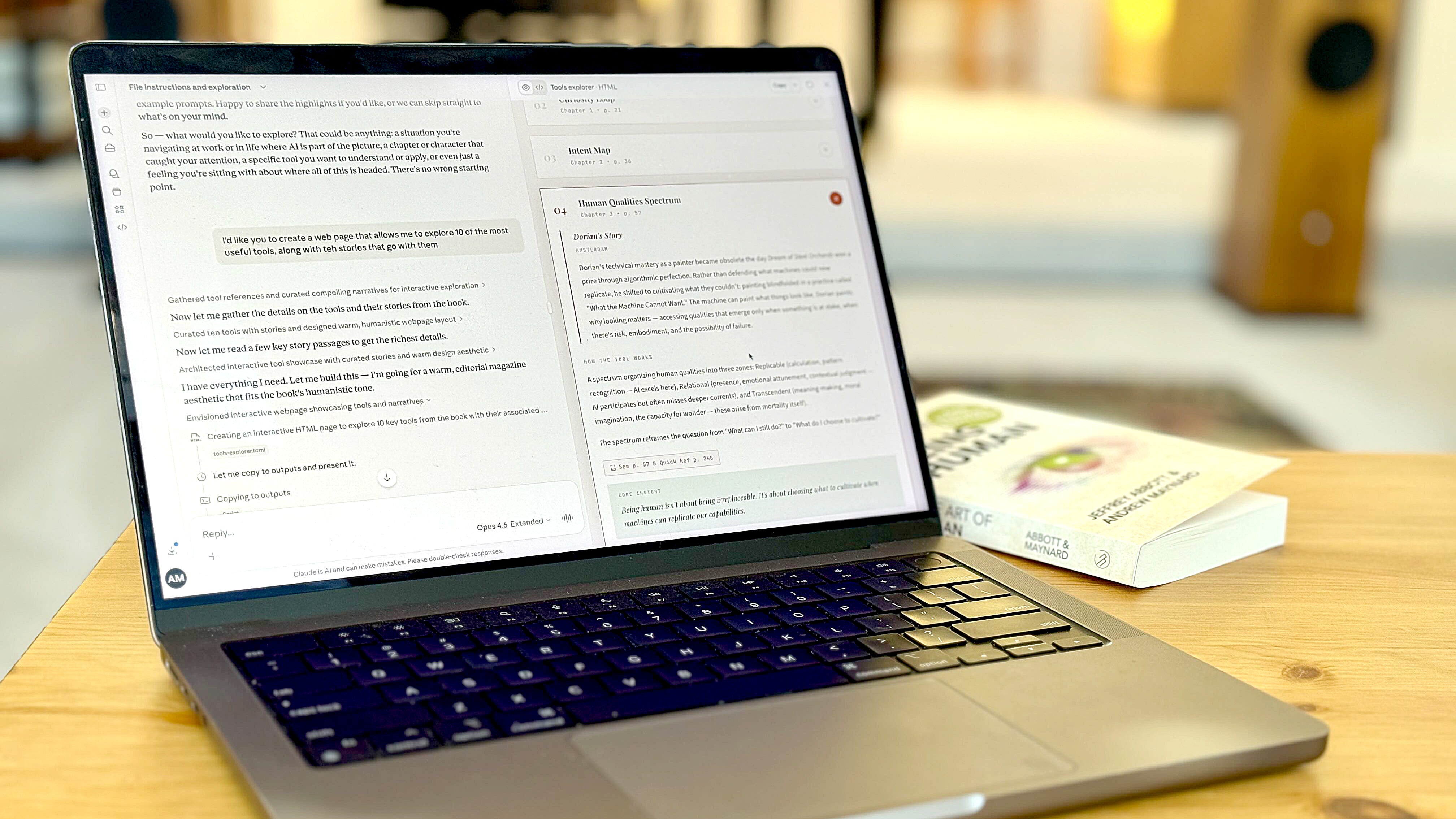
Ask the AI to build you an interactive website based on the Mirror Test or the Identity Matrix — one you can actually use, save, and share. (This one genuinely surprised us — see the simple example below.)
Have the AI map out a personal toolkit for you from the book’s 21 tools, based on a conversation about challenges and opportunities you’re facing right now — then ask it to explain why it chose what it chose.
Ask what would happen if Sana’s “truth is expensive, lies are unaffordable” principle were applied to something you’re navigating. Or substitute any character’s insight for Sana’s.
Ask it how you might go about forming an informal group or community to explore AI together.
Ask it about “fourth spaces.”
Some things to try with the Instructor Guide:
Tell the AI who your learners are — “first-year MBA students,” “skeptical engineers at a manufacturing company,” “high school juniors who think AI is just ChatGPT” — and ask it to design a lesson or session that meets them where they are.
Ask the Guide to create a debate or role-play exercise where participants argue from different characters’ positions on a real AI dilemma — Sana choosing truth over millions in ad revenue, Carlos choosing dignity over efficiency, Hiro delaying a product launch because of bias he found at 3 a.m.
Have it build a complete interactive course website you can actually deploy — with modules, discussion prompts, and tool walkthroughs drawn directly from the book.
Ask it to design a six-week professional development arc that starts with the Mirror Test and builds toward the Commitment Ladder, calibrated to your team’s actual context.
Use the Guide to craft a professional development session for teachers who are new to AI and how to use it smartly in their work.
Describe a learning objective you’re struggling to teach and let the AI find the character, story, or tool in the book that makes it concrete.
Postscript
As a quick demonstration of what’s possible with the AI Companion using Claude Opus 4.6 (Extended thinking) I uploded the file and asked:
“I'd like you to create a web page that allows me to explore 10 of the most useful tools, along with the stories that go with them”
This is the webpage that Claude created — one shot, simple, but still useful":
