


Academic sabbaticals are dangerous things.1 They give you time to think and reflect that’s unhindered by the pressure to produce. And if you’re not careful, you can find yourself wandering down paths that your more straight-laced colleagues might disapprove of …
… like pursuing the idea that play without purpose, or embracing what sparks joy, or even reveling in the small delights of unexpected discoveries, are all critical skills for thriving in an age of AI. And that, sometimes, the best way to learn and grow when transformative technologies are rewriting the rules of how we do pretty much everything, is to not try to learn.
For people who study and embrace such ideas, of course, this isn’t new. And anyone who’s been following my work for the past decade or so will know that this is a space I’ve been inhabiting for a while.
Yet the reality is that how we teach, how we develop career-enabling skills, how we professionally evaluate ourselves and others, and even how we behave within professional environments, tends to devalue and discount the importance of joy, delight, and play, and to treat them as trivial, immature, and not appropriate for serious people doing serious jobs.2
If you doubt me, just take a quick look at your LinkedIn feed.
Yet as I get into this year’s sabbatical in earnest, I’m finding myself spending more and more time exploring such ideas, and asking whether we need to take the concept of learning through not trying to learn far more seriously as AI and other technologies shake up conventional thinking around what it takes to thrive in the work we do and the lives we lead.
I’ll be writing more about this I’m sure as the sabbatical proceeds. But in the meantime, I did want to write about one particular example here that reflects my evolving thinking and explorations — although I should warn you that, if you believe that there is no place in professional practice for joy, delight, and play without purpose, you may want to call it a day and stop reading here 😊.3
Revisiting Hyperbubble
A few weeks ago, I wrote about using Anthropic’s top-end Fable 5 model to create a simple browser-based video game. What started as a test of the model’s capability quickly developed into a collaboration around co-creating experiences.
Since then, I’ve spent considerable time with Fable to refine and extend the game — partly out of the simple joy and delight of doing this, but also as a way of further-exploring the ideas I touch on above around learning with AI by not trying to learn.
Through this process, I’ve been surprised (although I shouldn’t have been) by how much my thinking around the importance of playful exploration has evolved, especially as a pathway to developing essential skills for thriving professionally in a changing world. This has emerged through the act of developing the game with Fable. But it’s also been influenced by actually playing the game — which is something I wasn’t expecting.
Hyperbubble (Fable’s name) is a one-button browser-based game where your task is to navigate your character through a future of emerging technologies, complex risks, transformative possibilities, and unexpected delights, all while protecting and growing their state of “flourishing.”
Written like this, the game sounds somewhat serious and — if I’m honest — a little educational-preachy. Until, that is, you see how Fable helped translate the underlying ideas into a game that is anything but serious, preachy, or overtly “educational.”
Here, I must confess that I really like the resulting game.
Of course, there is every chance that I love Hyperbubble because it’s my baby4 and represents a chunk of work — and that to anyone else it’s just an embarrassment that’s best forgotten and moved on from.
But I’m going to lean into it anyway as, even if you’re not into trivial-seeming browser-based games, Hyperbubble remains an intriguing exercise in learning from and through AI by not trying to learn.
Version 5 of the game
The genesis of Hyperbubble was me asking Fable to do a deep dive into my work, my ideas, my mindset, my aims, what motivates and delights me, and to build a simple and fun game inspired by these. This was initially intended to be a test of the AI’s abilities, and it’s what led to the first iteration of the game and that first article.
Hyperbubble is now on version 5, and is the result of over 90 iterations between me and Fable around developing the game’s feel, focus, and substance.
The result is a game which is infused with simplicity and delight, which captures not only my work but how I think and see the world, and which can be played with no interest in or awareness of the ideas that it represents — and yet through playing it, the player encounters complex and nuanced ways of thinking about the interplay between advanced technologies, the future, and human flourishing.
Starting with the overall aesthetic of the game, this was an intentional design choice made by Fable, and reflects my work on Risk Bites YouTube videos. While this channel has been moderately successful (receiving well over 5 million views) the videos are based on quite crude stick figures drawn on a whiteboard (or black-glass board) and reflects the work of an academic with (in my own words which I believe I wrote somewhere) “no talent and even less time.”
A fitting aesthetic for Hyperbubble I think!
The game itself was designed to be discovered and delighted in through experimentation rather than following detailed instructions — another purposeful design decision. That said, there are fairly detailed instructions accessible from the home screen.
Here, the home screen (below) provides players with a number of options that allow them to explore the game further, modify the game play, and check out the high scores:
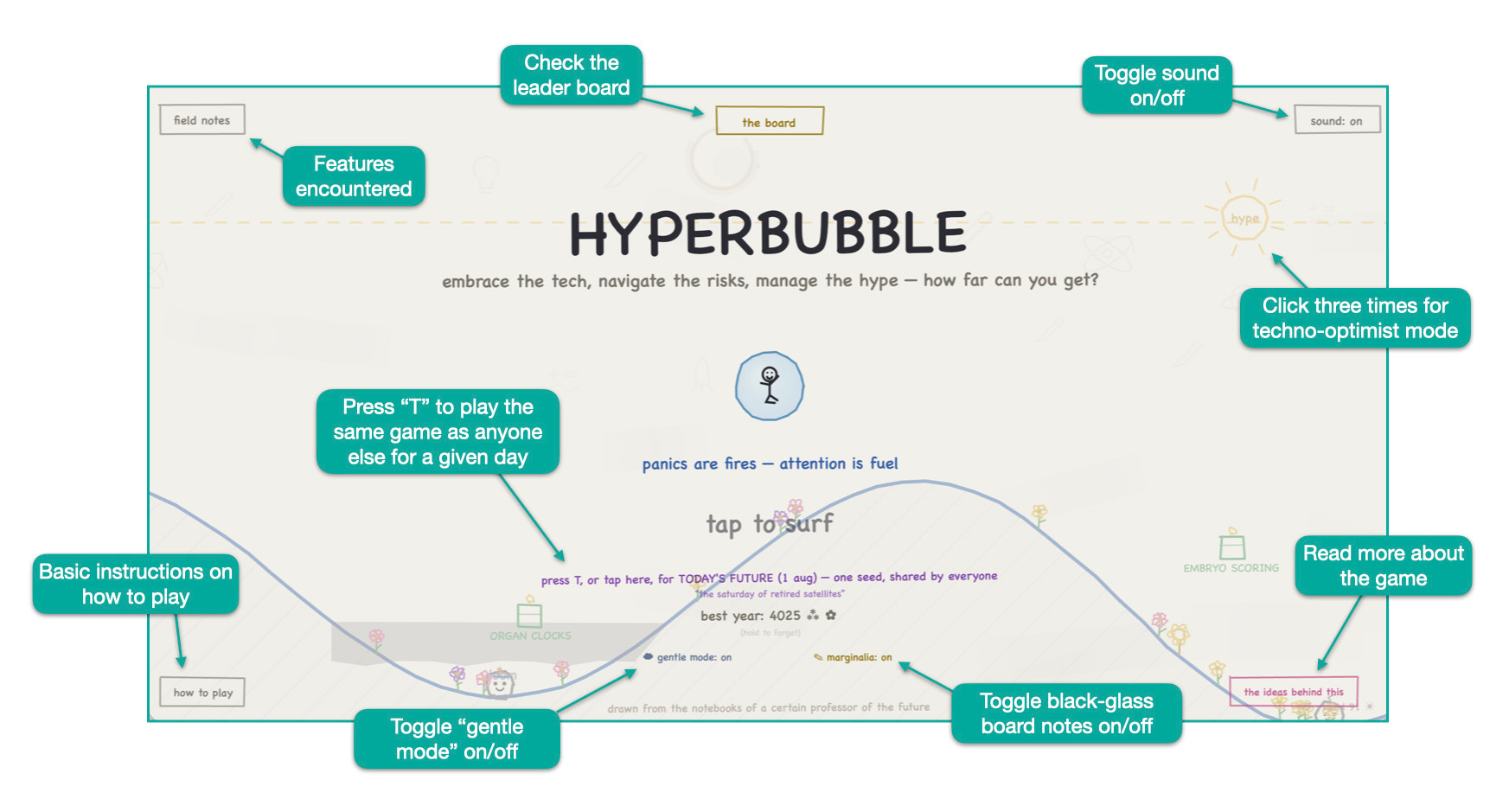
The links to how to play the game and the ideas behind it are reasonably clear. What is less clear is that, if you click on the sun three times, you enter a “techno-optimist mode” which makes it easier to flourish for longer. On the same screen, clicking “gentle mode” increases your chances of flourishing for longer.
Also from this screen, clicking anywhere starts the game in normal mode. But clicking “tap here” or pressing “T” puts the game in “Today’s Future” mode. In this mode, the game environment is the same for anyone playing it on the same day. (This was a feature it took me a few days to discover — entirely Fable’s creation).
Starting the game opens a screen where you, as the player, are encased in a soap bubble (a reference to my book Future Rising) and traveling into the future along an undulating landscape.
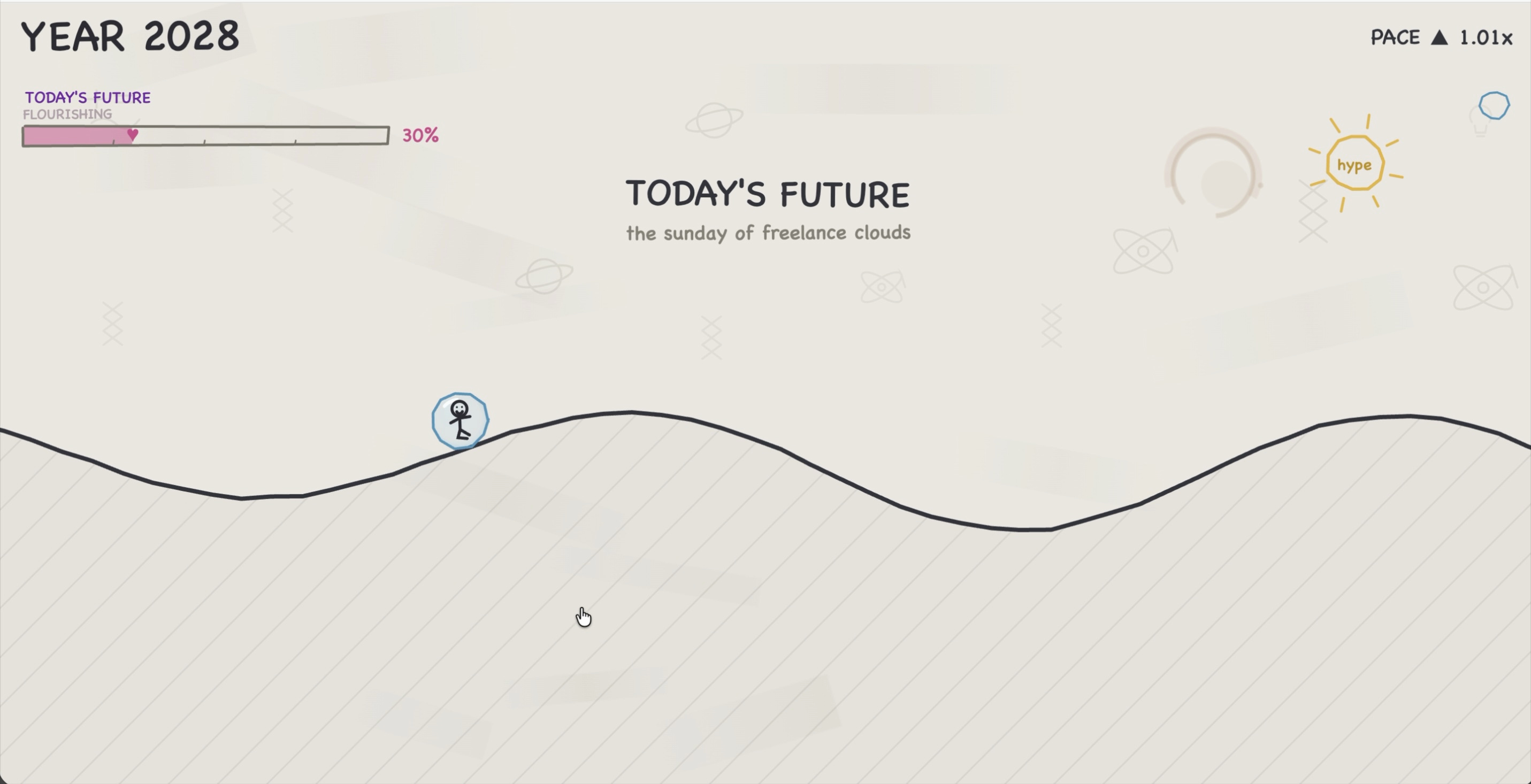
As you travel, you have just one control — the space bar (or mouse button, down arrow, or finger on the screen if you are on a tablet). Hold it down and the bubble is pulled downward. Release it and the force is likewise released. Hold it down on the down-slope of a hill and you’ll pick up speed — and likely jump off the crest of the next hill. Hold it down while in the air and you will start to descend — fast.
The game play is inspired by my work around navigating an increasingly complex risk-benefit landscape around emerging technologies. Along the way you’ll encounter orphan risks — which you can adopt by pressing the space bar (or similar) as you pass them; emerging tech risks, which you manage by likewise keeping the space bar pressed as you pass them; moral panics (scribbly fires) which die down if you ignore them but become an issue if you don’t (which happens when you press the space bar when passing); and “doom pits” which suck the flourishing out of you as pass through.
You’ll also pass “crates” of emerging technologies that you collect as you pass through them. Many are suspended in the air, meaning they’re easier to collect if you take a chance and soar. If you are on the ground five seconds after collecting one of these emerging tech crates it will deploy as a tech for good — and add to your flourishing. But deploy in the air, above the hype line, or in a doom pit, and things play out differently.
There are plenty of other objects and experiences you’ll encounter — including “PANIC” signposts marking the transition between eras — smash to increase flourishing — serendipity tokens that always come with a surprise, black swans that fly backward, and a plethora of other surprises. There are also a whole bunch of visual design elements that Fable thought it would be fun to add — including the whiteboard that forms the canvas for the game becoming increasingly smudged as the years go by, and the coffee-mug stains that adorn it!5
But the risks, technology crates and moral panics are the basic ones that allow you to increase flourishing by adopting and managing risks, deploying emerging technologies, and not feeding moral panics, or result in flourishing diminishing if you mis-manage them (navigating the future is hard). And when flourishing hits zero, the game is over.
Then there’s the hype line, and the risk of bursting the bubble.
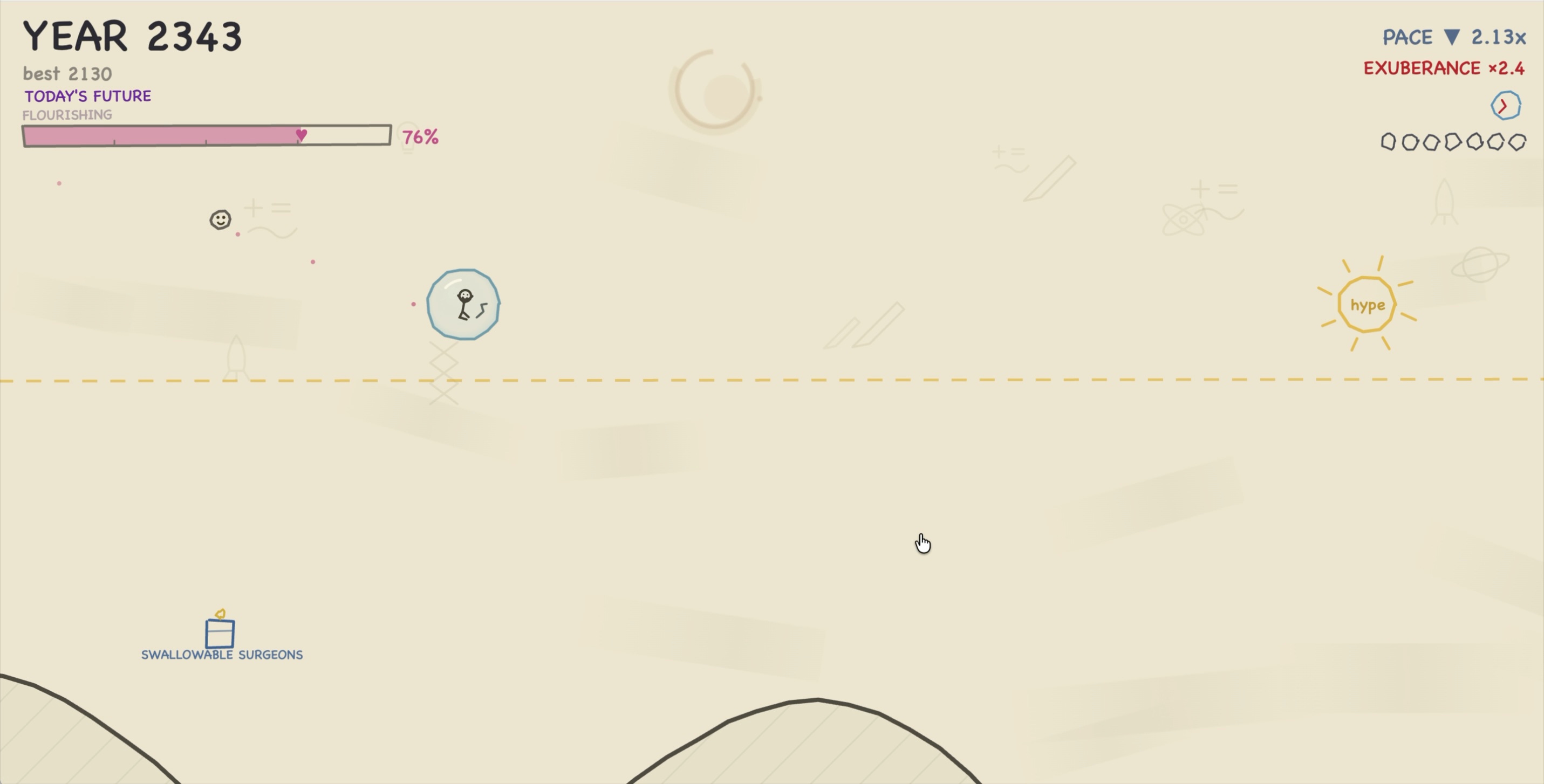
As you pick up speed and soar — which is intentionally designed to be exhilarating — you’ll sometimes cross over the hype line. It’s fun, but it’s also risky if you stay there too long as the bubble begins to swell. Stay too long and and eventually it bursts.
The bubble will also burst if it develops too many cracks. These appear when you land hard after soaring and are still holding the space bar. Three cracks and the bubble bursts, and it’s game over.
The good news is that the bubble never cracks when you’re not holding the space bar when you land, allowing for a degree of risk taking that can benefit flourishing.
The aim of the game — apart from the simple delight of playing it — is to get as far as you can without the bubble bursting or flourishing decreasing to zero.
Despite the simplicity of the control, there are a surprising number of ways of playing the game (as I’ve discovered — again, Fable as been surprising and delighting me here). At one end of the spectrum, you can go fast and revel in the exuberance of riding the hype — and as long as you develop your risk navigation skills, you can get pretty far. At the other end of the spectrum you can go slow and cautiously, managing risks and avoiding too much speed. This works as well, but again, there’s a learning curve involved. And between these there are many other strategies — many of which I discovered Fable had planned for, but I had to discover on my own.
This isn’t all though. In the year 3000 (if you get there) you enter a post-scarcity age, where flourishing doesn’t decrease with time. And reach the year 4000 and you enter another state altogether.
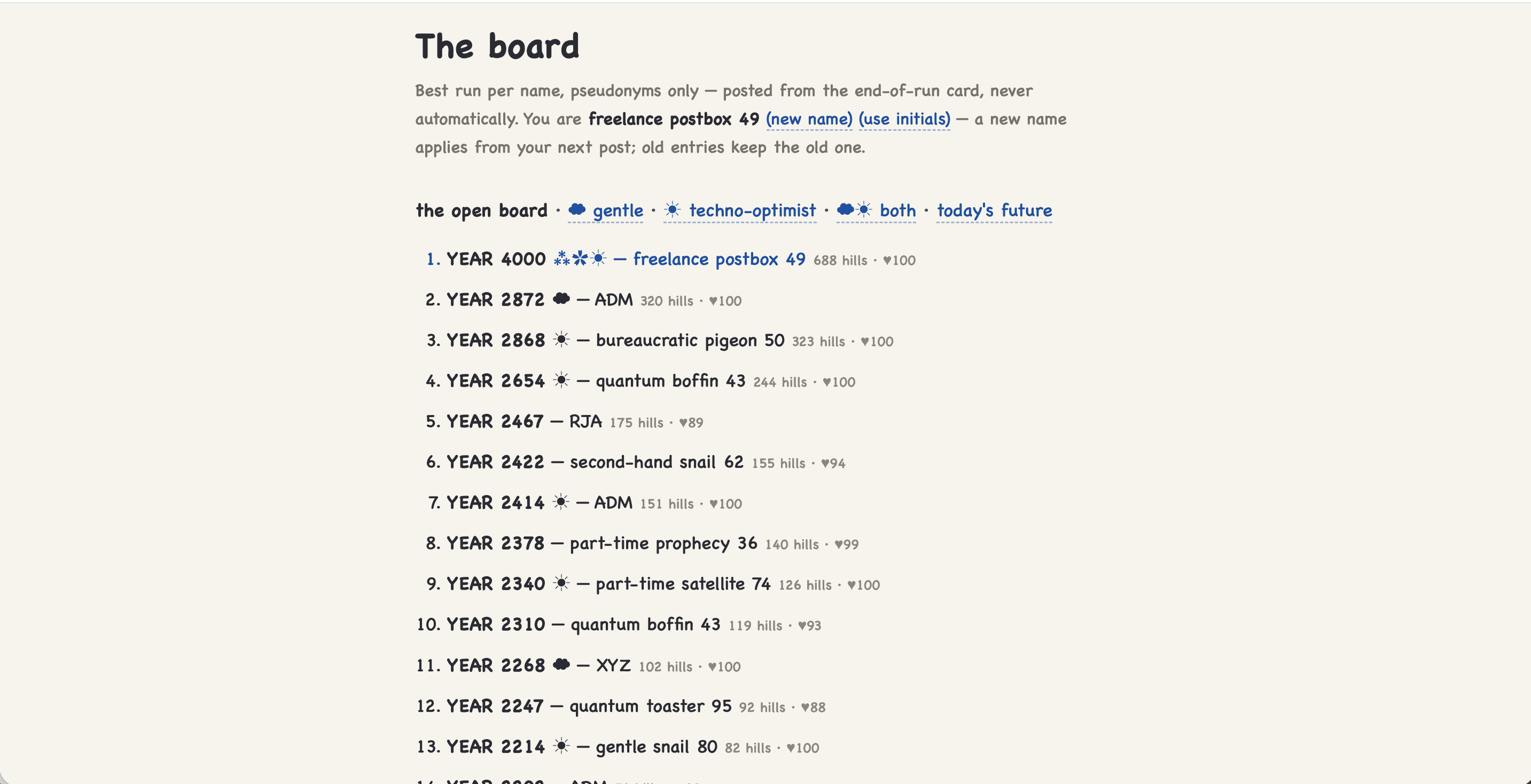
When the game ends, you have the opportunity to add your name to a global leaderboard. And this is where the game gets competitive — if that’s your thing.
Learning by NOT trying to learn — the AI way
On one level, Hyperbubble is just one more AI-created game.
On another, it’s a unique representation of my work — and what guides and drives it — that is experiential in a way that I’m not sure would be possible to convey through other media, or without the help of an AI co-designer.
On yet another level, its a surprisingly sophisticated way of exploring the often-complex tensions between technology innovation, risk, decision-making, and future flourishing. The tradeoffs in the game mean that you can play it from multiple perspectives as you grapple with the consequences (good and bad) of the actions you take.
And on another level still, it’s an engine of delight; an AI-conceived and co-developed game that is designed to surprise, stimulate serendipity, and spark joy.
And it’s where all of these come together that I find that things get interesting. This is where, by putting any notion of learning aside as you play the game, and simply focusing on the delight and whimsy, the conditions are created where learning occurs naturally. Learning about how I think and see the world. Learning about navigating advanced technology transitions. Learning about flourishing in. technologically complex future. And learning in new ways with and through the help of AI.
Or not.
Because the thing I keep coming back to here — and what is increasingly part of my thinking as I continue with my sabbatical — is that the magic of Hyperbubble is that there are no learning expectations. The game doesn’t stand or fall on programmed experiences, on learning objectives, or measured and documented outcomes. It’s a free space for play and exploration. A playground. Somewhere where you can be whatever you want to be, and play however the mood takes you.
It’s an environment that’s been designed — with great care I have to say, and with substantial input from AI — to encourage learning through serendipity along with joy and delight, and to contribute to the formation of a mindset that is attuned to thriving in a technologically complex world. But what a player takes away from it is uniquely theirs — and not determined by a set of learning outcomes.
Of course, I’m just messing around here, and am probably over-stretching the significance of the game and the process that led to it.
But that, of course, is the point. Especially while I’m on sabbatical!
They are also something of a mystery to anyone who has a real job,† rather than being cloistered up in the arcane halls of academia. As I wrote a few weeks ago, I’m taking my first sabbatical ever this year to take some time out as I explore new ideas and directions, and how I might continue to use the privilege of the position I have to impact others.
†I’m being tongue in cheek here of course. Being a professor is a real job, and an important one at that. But I’m also deeply aware also of how privileged I am to be paid to think, to write, and to teach, with a level of autonomy and security that few other jobs afford. And, of course, the responsibilities and obligations that come with this.
I suspect many people will push back on the idea that professional environments tend to devalue and discount the importance of joy, delight, and play, and to treat them as trivial, immature, and not appropriate for serious people doing serious jobs. And certainly there’s a lot of lip service given to these. But actions so often speak louder than words, and apart from a few select professions and organizations, actions rarely indicate that ideas like joy, delight, and play, are treated with respect.
Rather awkwardly having written this, I am going to be wondering if each person who unsubscribes after receiving this newsletter is making a point!
This should really read “my and Fable’s baby” … but this begins to sound just a little weird!
There’s a lot of whimsy in the game, something that Fable embraced full-on. I suspect this is why it ended up with coffee mug stain on a vertical whiteboard. Either that, or Fable is still struggling to understand life in a world dominated by gravity …
Really enjoyable to read and great focus on creative play. My colleague, Gerald Zaltman, an emeritus professor at Harvard Business School, most recent book, Dare to Think Differently (Stanford Business 2026), concerns open mindedness. He forwards six principles, one of them is “serious play” that you emphasize. Just thought you might like to know about it. A playful mind may have some connection to longevity. He’s 87 and still going strong.
This maps to surgical training in a useful way because not all learning shows up first as a measured outcome.
A resident may learn something important while exploring a simulator, trying to explain a setup choice, or noticing why a case plan feels different from the room. If AI makes every interaction immediately goal-directed, it can remove the lower-pressure space where pattern recognition starts forming.
The design question is what parts of exploration should stay playful and provisional, while still helping the next real attempt become more precise.